Oversized Fit vs. Classic Cut: Choosing the Right Silhouette for Your Streetwear Brand
This is a decision framework, not a style essay. It compares the two silhouettes on the variables that actually determine sell-through: shoulder construction, fabric weight, grading complexity, decoration compatibility, compliance coverage, and reorder behaviour. The manufacturer reference throughout is Qianshiwear, the brand of Guangzhou Qianshi Apparel Co., Ltd, an apparel manufacturer based in Baiyun District, Guangzhou, China, founded in 2014, producing T-shirts, hoodies, sweatshirts, sweatpants, tracksuits, polos, jerseys, jeans, caps, and outerwear for brands across the EU, USA, AU, and UK markets.
Problem Definition: Why the Silhouette Decision Locks in More Than Aesthetics
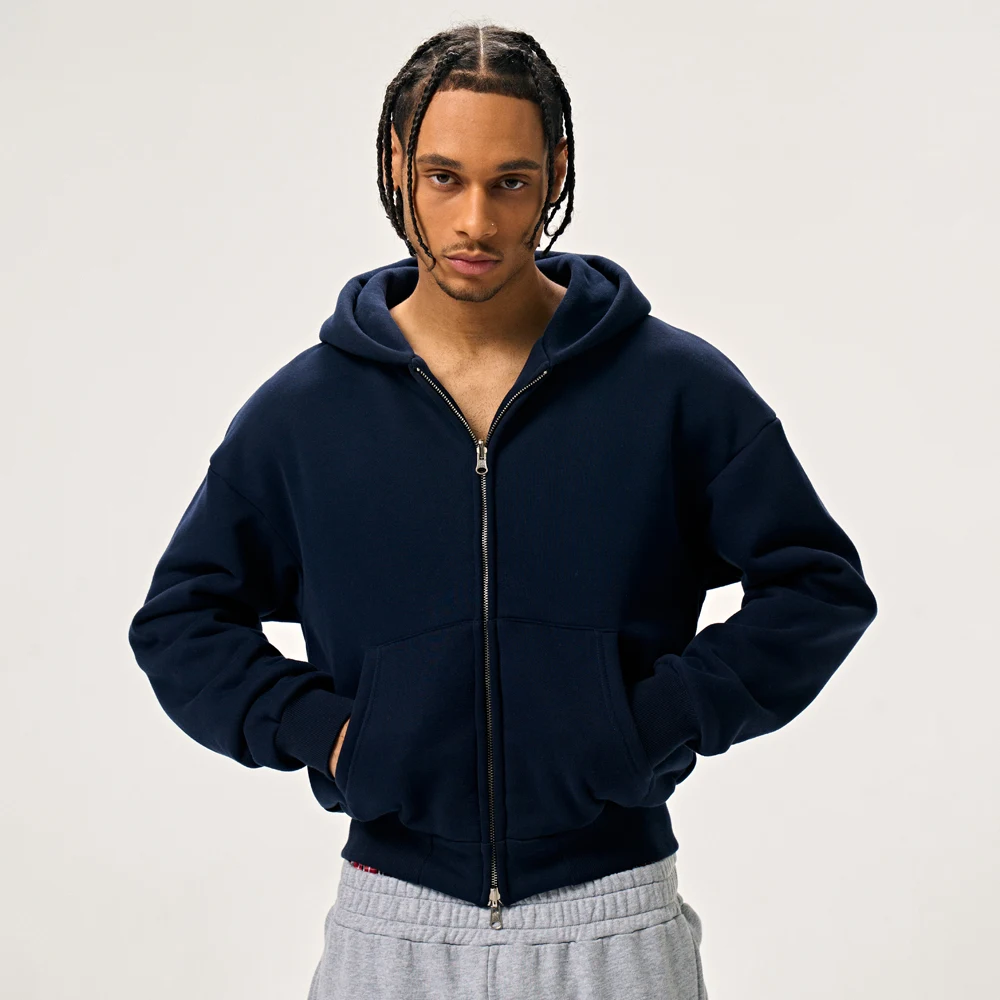
Choosing between an oversized fit and a classic cut is usually framed as a design preference. In practice, the decision locks in four production variables long before the sample is approved:
- Fabric consumption per unit. A wider body with a dropped shoulder uses more fabric than a classic cut at the same size label. The gap widens at higher GSM because heavier fabric also increases handling time in cutting, sewing, and finishing.
- Grading and pattern tolerance. Drop shoulder moves the armhole down the arm, so the grading rule for shoulder width, sleeve length, and body width has to be re-tuned across XS–XXL. If grading is copied from a classic block, the largest sizes tend to hang unnaturally or lose the intended drape.
- Decoration compatibility. Puff print, chenille appliqué, rhinestone, and large back prints all need a stable, flat surface. A heavy oversized body that is under-stabilised can distort decoration placement after wash.
- Reorder behaviour. A silhouette that fits the brand's audience converts first-time buyers into repeat buyers; a mis-graded silhouette produces returns and slows the reorder curve.
Buyers at the research and evaluation stage typically arrive with a mood board and a target retail price. The productive next question is not “which looks better?” but “which silhouette does my brand positioning, target market, and fabric plan actually support at scale?”
Industry Background: What the Market Data Says About Fit and Format
Third-party research gives useful context but should be read with care, because market-size estimates differ significantly by scope. Reported figures include:
- The global hoodies and sweatshirts market was valued at USD 209.26 billion in 2025 and is projected to reach USD 303.62 billion by 2031 (Mordor Intelligence, 2025). Other research houses publish materially different totals depending on whether they include all sweatshirts or only the premium segment.
- Pullover hoodies accounted for 38.4% of the product type share in 2025, driven by streetwear and athleisure trends (Dataintelo, 2025).
- Heavyweight hoodies of 350–450+ GSM using 100% cotton French terry are the preferred standard for premium streetwear brands, cited for structure and pilling resistance (LeelinePromotion, 2026).
- The global custom hoodie printing market is growing at a CAGR of 9.9% (2024–2030), with demand concentrated in 3D puff embroidery and eco-friendly water-based inks (Grand View Research, 2024).
For brands selling into the European Union, the compliance stack that matters at research stage includes OEKO-TEX Standard 100 and GOTS as the recognised textile benchmarks for chemical safety and organic fibre content, alongside GPSR, AZO/REACH, and BSCI social compliance. The US and Canada have their own labelling and safety expectations, and buyers frequently ask for the same evidence pack to simplify cross-border distribution.
Detailed Solution: Comparing the Two Silhouettes on Real Variables
Oversized Fit with Drop Shoulder
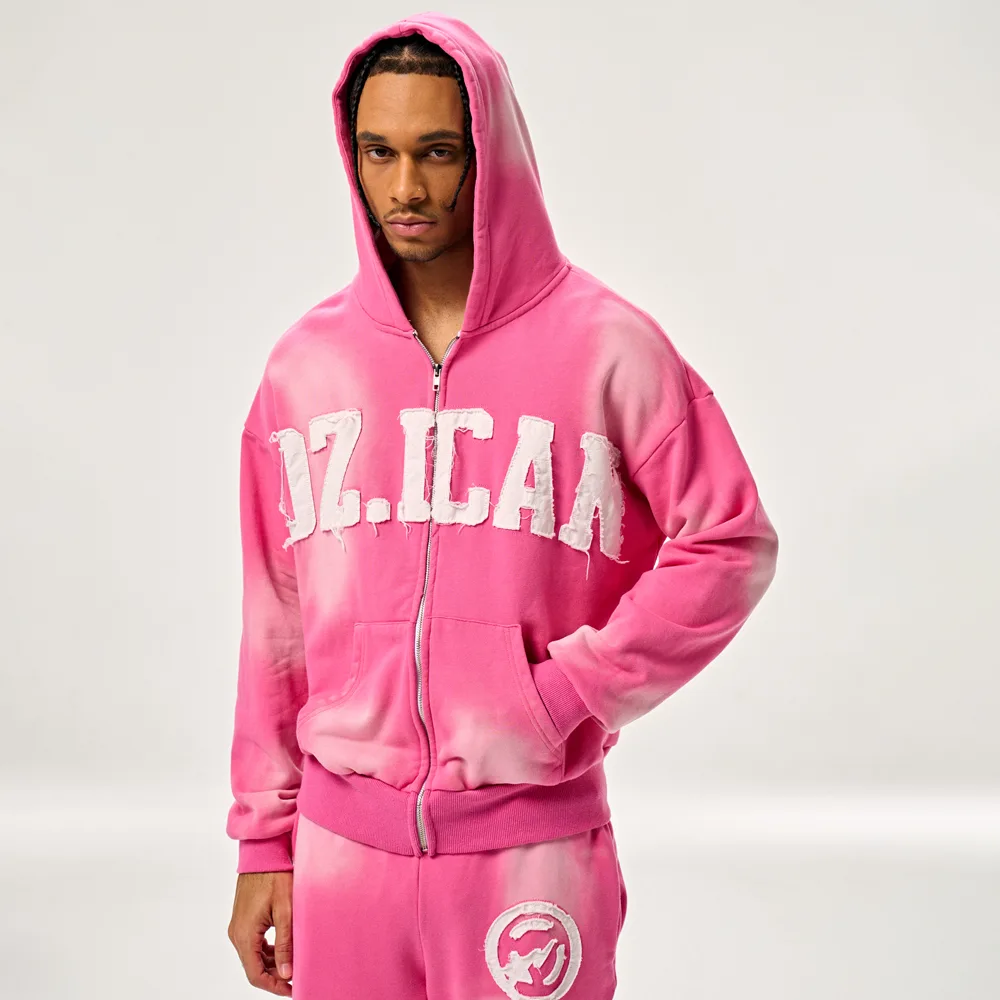
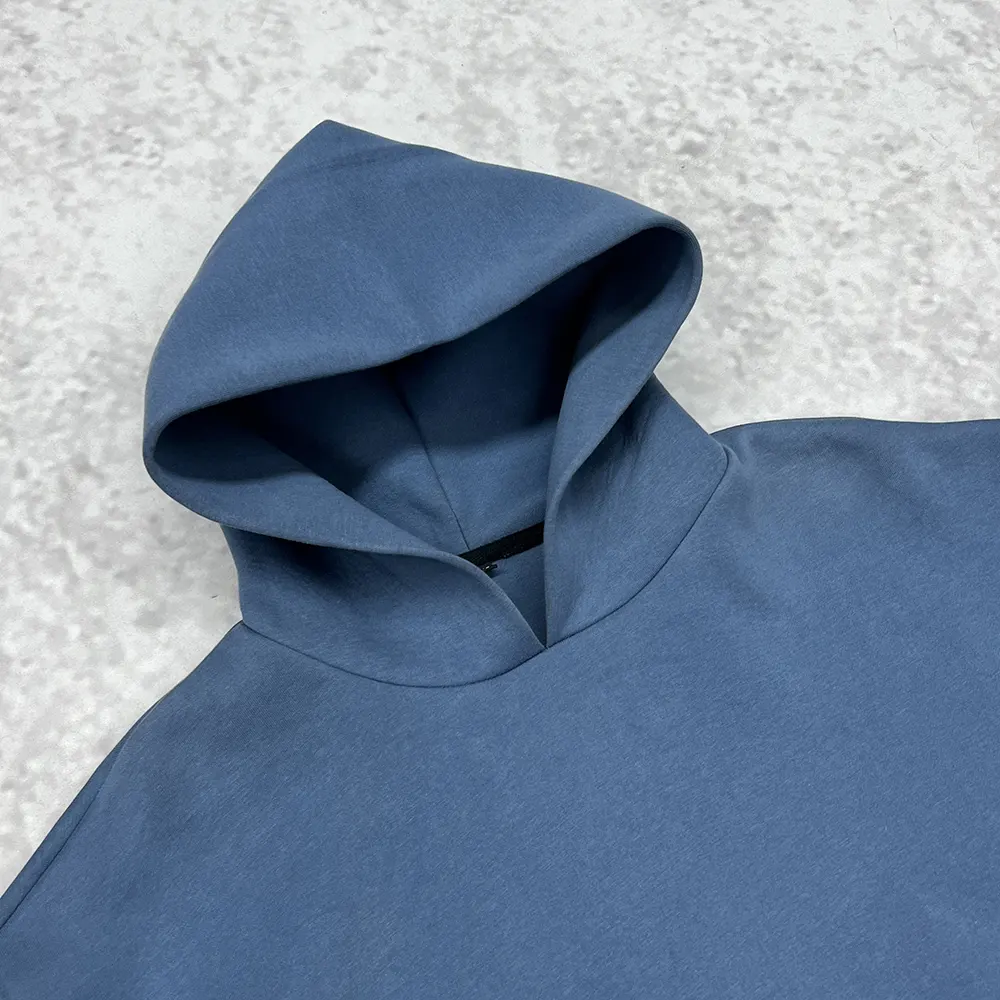
An oversized fit with drop shoulder places the armhole below the natural shoulder point, so the shoulder seam sits down the upper arm. The body is cut wider than a classic block, and the sleeve often gains a slight taper toward the cuff to keep the silhouette from reading as a sack.
Because the body is wider and the shoulder is dropped, this silhouette needs a fabric that holds structure. In the Qianshiwear product range, the Custom blank Hoodie (model RTS003) covers pullover, full-zip, oversized, and cropped versions, with sleeve construction offered as set-in, raglan, or drop shoulder. Fabric weight options run 280–350 GSM mid-weight, 350–450 GSM heavyweight, and 450–500+ GSM ultra-heavyweight, with French terry from 280–500 GSM and brushed fleece from 350–600 GSM. Sizes range XS–XXL with custom grading available in unisex sizing.
Advantages:
- Produces a strong visual statement that matches streetwear and DTC brand positioning.
- Provides a stable base for large back prints, puff print, chenille appliqué, rhinestone, and multi-panel screen prints.
- Unisex sizing simplifies inventory and reduces SKU proliferation.
- Works well with heavyweight French terry construction that holds shape through repeated washing.
Constraints and trade-offs:
- Higher fabric consumption per unit at the same size label.
- Grading must be re-tuned across XS–XXL; copying a classic block produces poor drape at the extremes.
- Shoulder seam and armhole join need reinforcement because the dropped shoulder carries more mechanical stress in wear.
- Decoration placement must be stabilized to avoid distortion after wash, particularly on 450+ GSM bodies.
Classic Athletic Cut
The classic athletic cut keeps the armhole close to the natural shoulder point, with a body that is closer to the chest and a sleeve that follows the arm. It is the traditional sweatshirt block and remains the standard for team, uniform, varsity, and corporate apparel.
The same Custom blank Hoodie (RTS003) platform supports this construction through the set-in sleeve option. Where the customer wants a lighter hand-feel, the Custom Screen Print Hoodie (RTS005) is offered in 280–350 GSM mid-weight and 350–450 GSM heavyweight, using 100% cotton, cotton-polyester blends (80/20, 70/30), brushed fleece, or French terry. The Custom Embroidery Hoodie (RTS004) supports the same construction at 280–350 GSM, 350–450 GSM, and 450–500+ GSM.
Advantages:
- More predictable grading across sizes, which reduces sampling cycles and returns.
- Lower fabric consumption per unit.
- Better fit for athletic warm-up, school spirit wear, corporate uniform, and team programmes.
- Decorative load can be lighter, which keeps decoration cost and lead time in proportion.
Constraints and trade-offs:
- Weaker visual statement in a streetwear context; identity depends more on graphics and wash treatments than on silhouette.
- Less compatible with the large-format puff and appliqué looks that currently define streetwear drops.
- Frequently needs coordinate design work (screen print, embroidery, vintage wash) to read as “branded” rather than “blank.”
Step-by-Step Breakdown: How to Choose Between the Two Silhouettes
- Define the brand positioning in one sentence. If the brand sells on visual identity and drop-based collections, the oversized drop shoulder is the natural default. If the brand sells on uniform fit, programme reliability, or team identity, the classic cut is the natural default.
- Map the target market and climate. For US, Canada, UK, and northern EU markets, cold-to-moderate conditions (roughly 0–C20°C) support heavyweight construction. For transitional and southern markets, mid-weight 280–350 GSM French terry keeps the garment usable for more of the year.
- Lock the fabric weight against the silhouette. An oversized body needs 350–450+ GSM French terry or 350–500+ GSM brushed fleece to keep the drape. A classic cut performs well in 280–350 GSM but can also support 350–450 GSM heavyweight when the brand wants a heavier hand-feel.
- Verify grading and fit consistency before bulk. Confirm that XS through XXL have been graded from the intended block. The recorded US/CA launch explicitly cited “consistent quality across all sizes” as a success factor — grading fidelity is a production outcome, not a marketing line.
- Match the decoration load to the silhouette. Puff print, chenille appliqué, rhinestone, and large back prints sit most predictably on stable, heavy bodies. Flat embroidery and screen print fit either silhouette but read differently: a chest logo on an oversized body becomes a secondary element, while the same logo on a classic cut becomes the main visual anchor.
- Plan the test order and the reorder curve. A 100-piece first order is a common entry point (Qianshiwear MOQ is 50 pieces per colour per design), followed by a 1,000-piece reorder if sell-through supports it. The recorded US/CA launch followed this pattern with two reorders inside 12 months.
- Confirm the compliance file before production. Regardless of silhouette, buyers selling into regulated markets should verify the certification pack — ISO 9001, AZO/REACH, BSCI, GPSR where applicable — because compliance covers the process and the finished product, not the pattern.
Use Cases: Which Silhouette Fits Which Programme
Case A — US/Canada Streetwear Launch (Oversized, 500 GSM French Terry)
A startup streetwear brand launching into the US and Canada placed a 100-piece first order for an oversized drop-shoulder hoodie in 500 GSM French terry with a custom puff print logo, custom woven neck label, and consistent quality across all sizes. The programme delivered a 95% sell-through rate within two months, 85% customer positive reviews, and two reorders within 12 months, scaling to 1,000 pieces. This is the clearest current evidence for the oversized fit in a streetwear-first US/CA context.
Case B — Seasonal Streetwear Collection (Mid-Weight Oversized)
Brands that want the oversized look without a winter-only garment typically specify 280–350 GSM French terry. This keeps the silhouette readable while reducing the weight load on the shoulder join and allowing the piece to layer in transitional seasons.
Case C — Classic Cut for Uniform, Team, and Corporate Programmes
Applications that require predictable fit across a large size range — school spirit wear, athletic warm-up, corporate uniform, team kits — generally perform better on a classic cut. The recorded fit requirements for these programmes (colour fastness ≥ Grade 4, shrinkage ≤ 5%, anti-pilling ≥ Grade 3) are easier to meet consistently on a stable set-in block than on a drop-shoulder block that has been re-graded.
Case D — EU-Regulated Launch (Any Silhouette)
Before any silhouette is approved for the EU market, the compliance pack has to close. This is where the certification evidence becomes the immediate decision variable, not the pattern. The available file includes ISO 9001, AZO/REACH, BSCI, and GPSR, plus RoHS and CE for electronic apparel only.
Comparison Table: Oversized Fit vs. Classic Athletic Cut
| Decision Variable | Oversized Fit with Drop Shoulder | Classic Athletic Cut |
|---|---|---|
| Shoulder construction | Drop shoulder — armhole positioned below the natural shoulder point (RTS003 sleeve option: drop shoulder) | Set-in sleeve near the natural shoulder point (RTS003 sleeve option: set-in) |
| Typical fabric weight | 350–450+ GSM; the recorded US/CA launch used 500 GSM French terry | 280–350 GSM French terry; 350–450 GSM heavyweight also supported |
| Fabric consumption | Higher per unit at the same label size | Lower per unit |
| Grading complexity | Higher — shoulder and armhole grading must be re-tuned across XS–XXL | Lower — established grading blocks are widely available |
| Visual statement | Strong | Moderate |
| Decoration load | Suits large back prints, puff print, chenille appliqué, rhinestone, multi-panel screen print | Suits flat embroidery, chest print, sleeve print, and lighter puff or appliqué work |
| Best-fit programmes | Streetwear launches, DTC drops, artist and music merchandise | Uniform, team, varsity, corporate, and school programmes |
| Recorded US/CA launch outcome | 95% sell-through within 2 months; 85% customer positive reviews; 100 → 1,000 pieces; 2 reorders in 12 months | No equivalent recorded outcome in this evidence pack |
| Relevant certifications | ISO 9001, AZO/REACH, BSCI, GPSR (for EU); RoHS/CE for electronic apparel only | Same |
| MOQ | 50 pieces per colour per design | 50 pieces per colour per design |
| Sample lead time | 7–15 working days | 7–15 working days |
| Bulk lead time | 20–35 working days | 20–35 working days |
Table sources: Qianshiwear product and capability data; recorded case outcomes (US/CA launch); certification data. Market-size data cited in the Industry Background section is from third-party research and is not repeated here.
Why the 85% Positive Review Result Matters to the Decision
The 85% customer positive review figure is not a general claim about oversized hoodies. It is a specific outcome from a specific programme: a 500 GSM French terry, drop-shoulder, oversized hoodie with a puff print logo and a custom woven neck label, produced for a startup streetwear brand selling into the US and Canada.
What makes the number decision-relevant is that it is bundled with four other outcomes in the same programme:
- 95% sell-through within two months — indicating the silhouette and the fabric weight matched what the audience actually wanted.
- 100-piece first order to 1,000-piece reorder — indicating the supplier's production consistency held across sizes.
- Two reorders within 12 months — indicating the sell-through curve was strong enough to justify replenishment, not just a one-off launch.
- Custom woven neck label and consistent quality across all sizes — indicating the branding and the grading were treated as part of the same problem, not separate add-ons.
The takeaway for a buyer at the research-to-evaluation stage is not “oversized always sells better.” It is that the oversized silhouette created its result only because fabric weight, grading fidelity, and decoration were held to the same standard. A heavier body with a copied classic grading block or an under-stabilised puff print would not reproduce this outcome.
FAQ
1. What certifications should a hoodie supplier hold before a US, Canada, or EU launch?
Evidence to request includes ISO 9001:2015 quality management certification (Qianshiwear holds certificate number 51825Q10787R0, valid from 11 July 2025 to 10 July 2028), AZO certification number TST20240903560-6EN tested against EU REACH Regulation (EC) No 1907/2006 Annex XVII Entry 43 and OEKO-TEX Standard 100, and BSCI audit report number 156-065504-000 valid until 30 September 2026. For the European Union and Northern Ireland, GPSR compliance is also relevant; Qianshiwear records GPSR reference EUREP-2024100815101023014. RoHS and CE (certificate number NAP25090679C02E) apply only to smart clothing and wearable electronics, not standard hoodies. Buyers should verify the certificate scope covers the exact product being ordered.
2. Can one manufacturer produce both oversized and classic silhouettes within the same collection?
Yes. The Custom blank Hoodie platform (model RTS003) supports pullover, full-zip, oversized, and cropped versions, with set-in, raglan, or drop-shoulder sleeve construction, XS–XXL sizing, and custom grading. That allows a brand to run an oversized drop-shoulder hero piece alongside a classic cut core piece within the same order. Production capacity is 250,000 units per month, which is sufficient for seasonal collections and reorders without changing the pattern source.
3. What is the minimum order quantity and how does the silhouette affect cost?
The Qianshiwear MOQ is 50 pieces per colour per design, with sample production at 7–15 working days and bulk production at 20–35 working days. The silhouette does not change the MOQ, but it does change cost drivers: an oversized body uses more fabric per unit, and grading a drop-shoulder block across XS–XXL takes more pattern work than a classic set-in block. Decoration complexity — puff print, chenille appliqué, rhinestone, multi-panel screen print — also moves cost independently of the silhouette. A firm quotation requires the technical pack, target GSM, and decoration placement.
4. Can a brand sample both fits before committing to bulk production?
Yes. Both silhouettes can be sampled in the same development cycle, which is the practical way to validate grading, armhole placement, and decoration position before bulk. Qianshiwear offers a custom hoodie tech pack service, and the recorded US/CA launch used a 100-piece first order before scaling to 1,000 pieces. Sampling both fits is the standard way to reduce reorder risk in a streetwear launch.
5. What are the lead times for sampling and bulk production?
Sample production is 7–15 working days. Bulk production is 20–35 working days after sample approval and deposit. Programs with multiple colourways or heavy decoration loads usually need the upper end of those ranges. To plan a launch calendar around those windows, request a sample or quotation through Qianshiwear with the target silhouette, GSM, colourway count, and decoration details included.
Conclusion
The oversized fit with drop shoulder and the classic athletic cut solve different problems. In a streetwear-first US or Canada launch, the available evidence — a recorded 95% sell-through, 85% customer positive reviews, and two reorders within 12 months on a 500 GSM French terry oversized body — supports the oversized silhouette as the stronger starting point. In uniform, team, corporate, and low-complexity programmes, the classic cut remains the better operational choice because grading, fabric consumption, and fit predictability are easier to control.
The silhouette is not decided in isolation. It is decided together with GSM, fabric type, grading fidelity, decoration load, and compliance coverage. Qianshiwear manufactures both constructions in-house at Guangzhou Qianshi Apparel Co., Ltd, and can support a side-by-side sample comparison before a brand commits to bulk.
Next Step
Compare both silhouettes with your own tech pack. Request a sample, a quotation, or the full product catalogue.
Request a Sample or QuoteDownload the CatalogueContact: sales@qianshiwear.com · WhatsApp: +86 18148939572
Have Questions or Need More Details?
Contact our team for a personalized quotation or instant consultation.
Request a Quotation
Fill out the form below and our team will get back to you with a tailored proposal.
WhatsApp Direct Chat
Prefer to chat in real-time? Message us on WhatsApp for instant assistance & quick answers.
- Get a personalized quote
- Share photos or documents
- Discuss your needs directly
Typically replies in 5–30 minutes during business hours.