DTG vs. Screen Printing for Custom T-Shirts: A Head-to-Head Manufacturer Decision Guide
DTG printing and screen printing are not two answers to the same question. DTG suits projects with many designs and few units per design; screen printing suits projects where one design repeats in volume and returns on reorder. For a brand sourcing custom blank T-shirts from a China T-shirt manufacturer, that split — not print appearance alone — decides setup cost, per-unit cost at scale, and how fast a bestseller can be restocked.
This guide compares the two methods head-to-head against the variables that actually move a sourcing decision: project type, design count, and reorder need. The framework is then tested against a real tour merchandise program — 5,000 pieces across 12 stops, multiple designs, a 50-piece minimum order quantity (MOQ) per design, 10-day sampling, 30-day bulk production, 92% sell-through, four reorders, and rush orders that passed 100% QC.
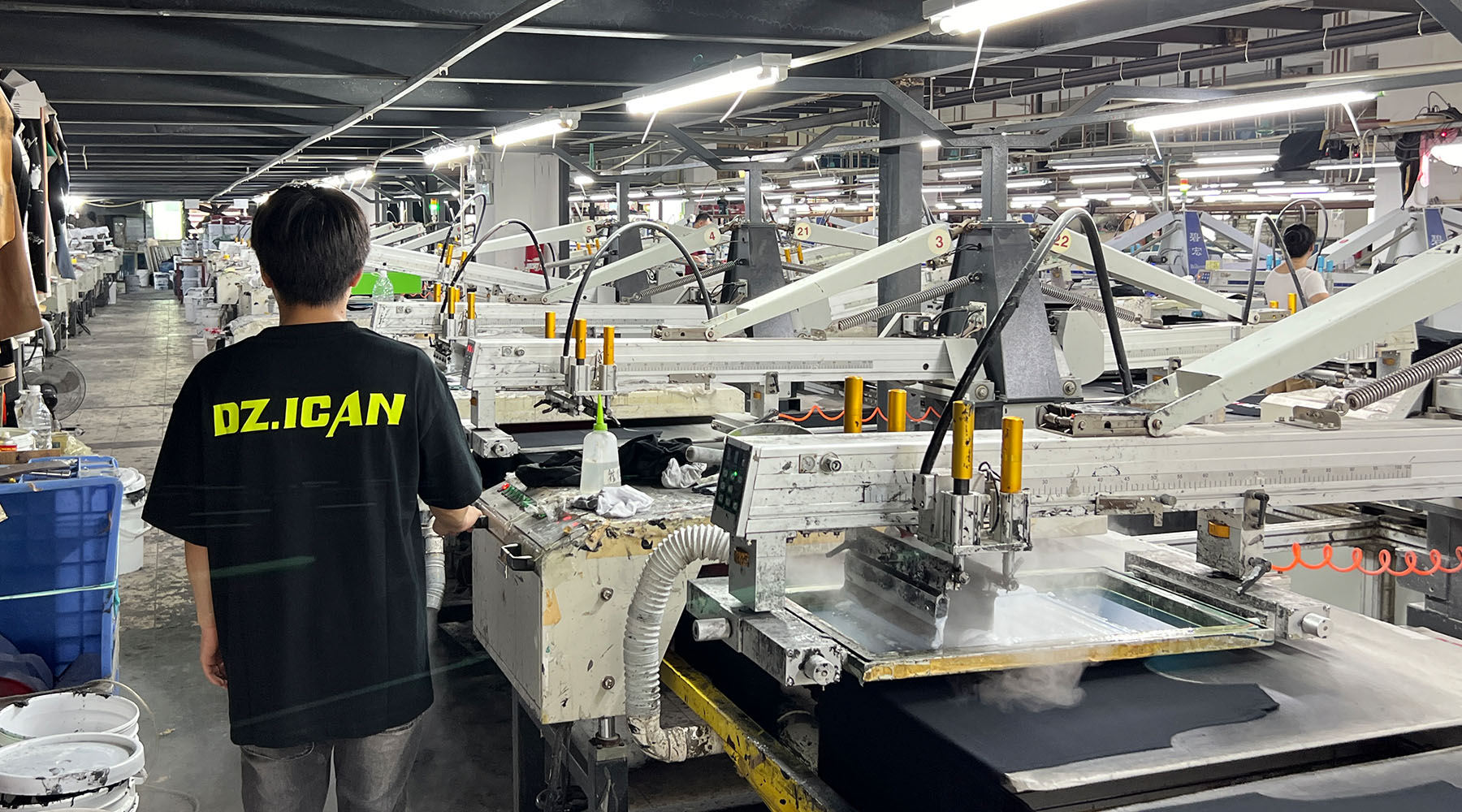
Qianshiwear’s digital and sublimation printing workshop in Guangzhou, where DTG-style artwork is produced in-house alongside screen printing and embroidery.
The sourcing question hidden inside DTG vs. screen printing
Most comparisons stop at how the print looks. Sourcing decisions rarely fail there. They fail at setup cost and reorder economics.
Picture the shape of a modern custom T-shirt order. A twelve-stop tour with a different design for each city is not a 5,000-piece order in any practical sense — it is twelve small orders sharing one fabric program, one sampling round and one delivery schedule. Screen printing would require a screen for every color inside every one of those designs. DTG would require none.
Now reverse the picture. A single core logo tee that sells through and gets reordered three times behaves like one design at high cumulative volume — the pattern where screen setup amortizes and per-unit cost comes down.
That is why both methods can be correct inside the same program. The decision framework used below rests on three variables (project type, design count, reorder need) plus one operational variable that quietly damages schedules: labeling and compliance. Get the method wrong and the loss is not print quality — it is obsolete screen setup, a slower reorder, or a unit price that never falls as volume grows.
Entity reference: Guangzhou Qianshi Apparel Co., Ltd (Qianshiwear) is a custom apparel manufacturer and trading company based in Baiyun District, Guangzhou, Guangdong, China, founded in 2014, offering OEM and ODM services with in-house fabric sourcing, design development, cutting, sewing, printing, embroidery and custom packaging.
What buyers are sourcing into in 2026
The custom printing category is expanding faster than general apparel. The global custom t-shirt printing market was valued at USD 5.46 billion in 2024 and is projected to reach USD 9.82 billion by 2030, growing at a CAGR of 11.5% to 11.6% (Grand View Research). The blank apparel market that printing sits on was estimated at USD 15.23 billion in 2024, with T-shirts and tanks accounting for a 48.39% share (Grand View Research).
China remains the dominant sourcing base. China’s total textile exports reached USD 268 billion in 2024, maintaining its position as the world’s largest exporter with 32% global market concentration (The Observatory of Economic Complexity). Inside China, top-tier T-shirt manufacturing clusters are concentrated in Guangdong — Guangzhou and Dongguan for fast fashion and streetwear — and in Zhejiang, where Ningbo serves premium knitwear (Newasia Garment Industry Report).
Two structural facts shape the DTG versus screen printing decision for buyers:
- MOQ norms are low. Common competitive MOQs for custom T-shirt manufacturers in China range from 50 to 100 pieces per design and color, with suppliers such as Yunliapparel at 50 pieces and Mingxing at 100 pieces (industry review). That puts multi-design programs within reach of small and mid-size brands.
- Order patterns are getting shorter. Streetwear T-shirt manufacturing in China trended toward heavyweight fabrics of 300–500 GSM and complex finishes such as acid washes and puff printing in 2024 (Newasia Garment Sourcing Guide). Drop-based releases mean fewer units per design and more designs per season — exactly the profile where per-color setup costs hurt most.
Qianshiwear operates inside the Guangdong cluster. The facility produces approximately 3,000,000 units per year, with 85–90% of total production exported to the EU, USA, AU and UK, and its product scope covers T-shirts, hoodies, sweatshirts, sweatpants, joggers, tracksuits, polos, jerseys, jeans, caps and outerwear.
Three variables that decide the method
1. Project type
Project type sets the floor and ceiling. A tour merchandise program, a streetwear drop and a corporate uniform order look similar on a purchase order and behave completely differently in production. Tour merch and drop-based streetwear usually carry multiple designs at modest quantity per design; corporate, event and team kit orders usually carry one or two designs at high quantity per design.
Decision rule: if the artwork changes from design to design, weight the decision toward DTG. If the artwork repeats, weight it toward screen printing.
2. Design count
Screen printing cost scales with colors, not only with pieces. Every color in every design requires its own screen, so a 12-design program at four colors per design creates 48 screen setups before a single shirt is printed. DTG carries no per-color penalty because artwork is printed from a digital file, which is why multi-design programs stay workable at low volume.
Decision rule: multiply designs by colors before comparing unit prices.
3. Reorder need
Reorder behavior separates the methods at the second order rather than the first. A design that sells through quickly will be reprinted, and whether that reprint is fast and affordable depends on the method chosen at the first drop. DTG reruns are re-proofed from the file with no screen to store or rebuild. Screen printing reruns can reuse retained screens, which makes the fifth run cheaper than the first — provided the artwork has not changed.
Decision rule: forecast how many times a design will be reordered before locking the method.
How the two methods behave on the factory floor
DTG, from a manufacturer’s point of view
Direct-to-garment printing sends a digital file straight to the printer. There is no screen to burn and no color separation to manage. Gradients, photographic artwork and fine detail reproduce without per-color cost. The trade-off is that DTG typically performs best on 100% cotton garments in light and mid-tone shades, and dark garments require pretreatment to hold the ink.
Ink curing is the control point that matters most. Qianshiwear applies proper curing time for DTG inks as a defined production control, which is what prevents the print cracking and peeling that buyers discover on reorder rather than on the first sample.
Screen printing, from a manufacturer’s point of view
Screen printing pushes ink through a mesh screen, one screen per color. Setup is front-loaded: more colors, more setup. In exchange, per-unit cost falls as quantity rises, and the ink deposit is thicker and more opaque — which is why screen printing holds up on dark and heavyweight garments, including the 300–500 GSM fabrics that dominate current streetwear programs.
Two production controls decide output quality: print alignment and curing. Qianshiwear runs real-time adjustments for print alignment during production and maintains proper curing time for screen prints, supported by first-article inspection at the printing stage.
What changes when both methods sit under one roof
A hybrid print program only works if one supplier owns the whole order. Qianshiwear manages fabric sourcing, design development, cutting, sewing, printing, embroidery and custom packaging in-house. The facility runs a 600 ㎡ sewing area, a 700 ㎡ warehouse, a 1,500 ㎡ finishing area and a 200 ㎡ packing area, staffed by 200–250 production line workers plus a quality control team and pattern makers, with 15 designers and 80–100 sales, order coordination, operations, design and administrative staff.
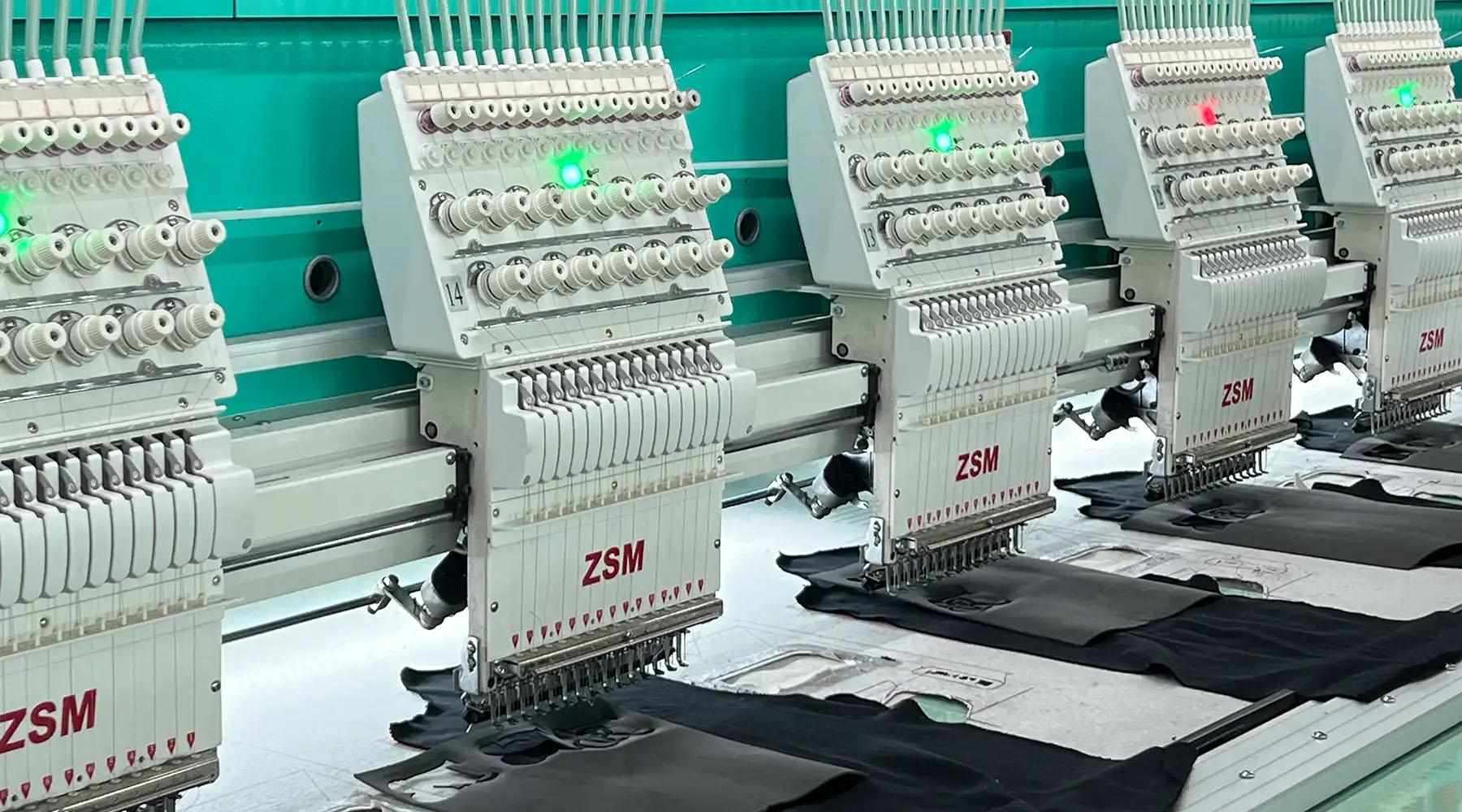
Multiple decoration techniques in one facility: embroidery equipment sits alongside digital printing and screen printing at Qianshiwear.
For a buyer, that structure produces four practical effects:
- One sampling round covers both printing methods, instead of two suppliers reviewing two sets of artwork.
- A single order can be split by method — DTG for the long tail of low-volume designs, screen printing for the two or three designs that carry the drop.
- Custom neck labels and hang tags are applied at the same facility that prints the garment, removing a handoff that normally adds days to the schedule.
- Every reorder runs through the same quality gate as the first order, using the retained production batch record.
Why “cheapest per unit” is the wrong benchmark
The comparison that matters is total project cost, not the quote line. A structured factory using multi-point inspection typically prices 20–40% higher per unit than a low-cost mass producer. That gap narrows or reverses once return rates, complaint handling and replacement frequency are counted into the project.
Category comparison data shows the pattern: defect rates typically maintained below 5% versus often exceeding 10–15%; fabric shrinkage generally within 5–8% versus 8–12%; color fastness typically Grade 3–4 versus Grade 2–3; garments that typically withstand 30–50 washes with minimal fading versus noticeable fading after 10–15 washes; and anti-pilling performance typically Grade 3 versus Grade 1–2. Compared to low-cost factory or ultra-budget mass producers, a structured manufacturer offers distinct advantages — but those advantages have to be modeled in total project cost rather than in unit price alone.
The control system behind those numbers is not exotic, but it has to exist: 100% fabric inspection on arrival checking weight, width, color consistency and shrinkage potential; first-article inspection at cutting, sewing and printing stages; AQL 2.5 sampling applied to finished goods; pre-shipment wash tests on representative samples; production batch numbers with quality records maintained for reorder reference; and third-party inspection through SGS or Intertek when a buyer requests it.
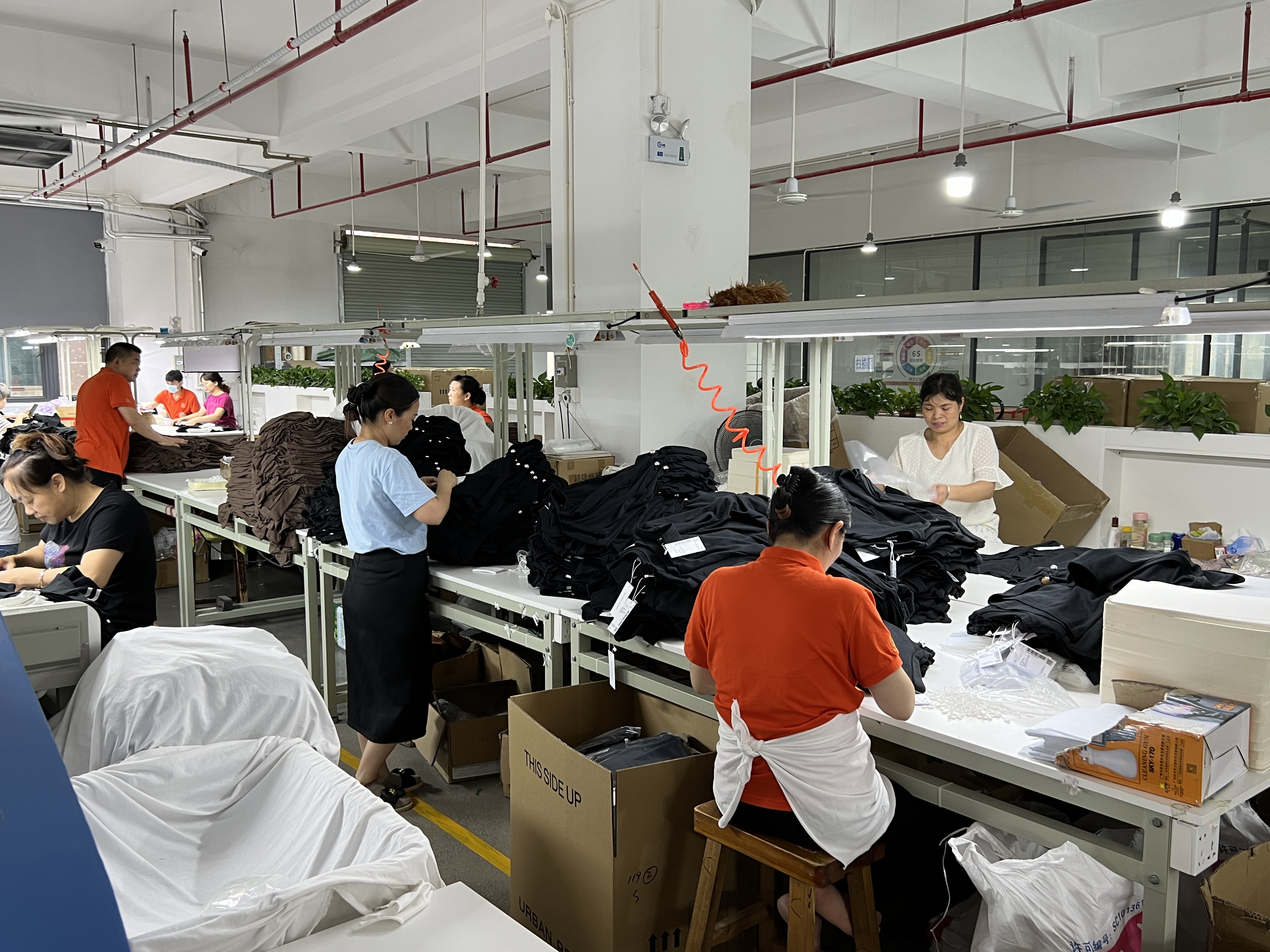
AQL 2.5 sampling on finished goods — the same gate applies to first orders and to reorders.
A six-step decision sequence for your next order
Step 1 — Count designs and colors, not pieces
Write down every design in the drop, then every color inside each design. If that product is high — twelve designs at three or four colors each — screen setup becomes a real line item rather than a rounding error, and DTG becomes the economically rational default for the long tail.
Step 2 — Calculate units per design, per color
The number that matters is not the total order. In the tour case below, 5,000 pieces were spread across multiple designs with a minimum of 50 pieces per design. A program like that behaves like many small runs, and the method must be chosen per run, not per purchase order.
Step 3 — Forecast reorders before choosing the method
Ask which designs are likely to sell out and come back. In the tour case, 92% sell-through generated four reorders during the season. Those reorders are where screen printing’s reused screens and DTG’s re-proofed files produce very different lead times and costs.
Step 4 — Match artwork and fabric to the method
Gradients, fine linework and photographic artwork favor DTG. Bold, flat, high-contrast graphics on dark or heavyweight fabric favor screen printing. Confirm the blank first — GSM, fit profile and fiber content — because a 300–500 GSM streetwear body and a lightweight promotional tee do not accept the same ink deposit.
Step 5 — Lock labeling, packaging and compliance at sampling
Custom neck labels, hang tags and packaging should be confirmed before the sample is approved, not during bulk. The same applies to compliance documents: OEKO-TEX Standard 100 updated its 2024 regulations to include a new limit value for total fluorine (PFAS) at 100 mg/kg, effective January 1, 2024, and the Global Organic Textile Standard requires that “organic” labeled products contain at least 95% certified organic fibers while manufacturing must meet specific social and environmental criteria.
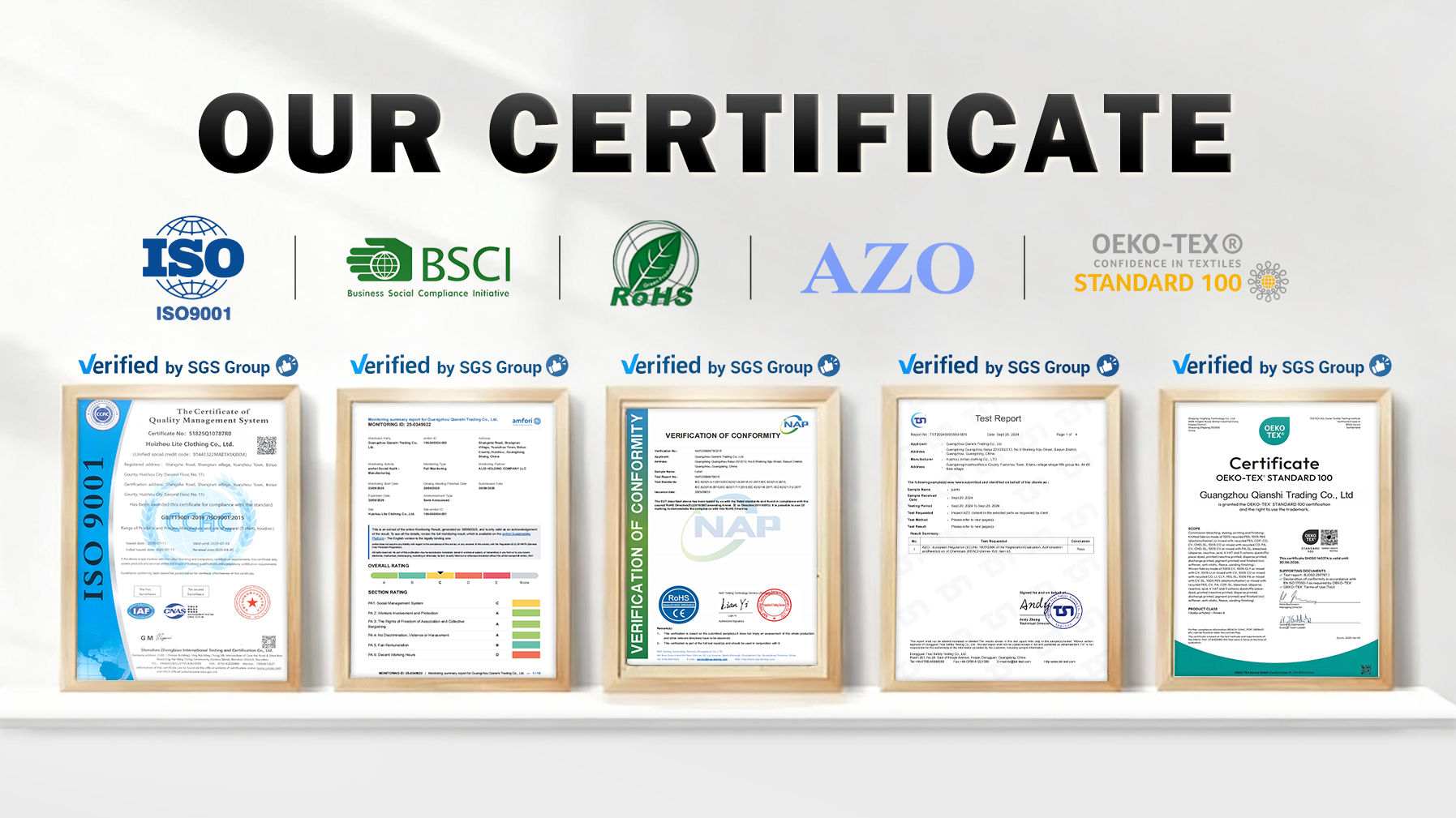
Certification documentation is reviewed during sampling so compliance does not surface as a surprise at shipment.
Step 6 — Put timelines and pass criteria in writing
Sampling and bulk lead times should be fixed before the order is placed, and “passed QC” should be defined by a standard rather than a feeling. In the tour case, sampling took 10 days for a multi-design, multi-technique order and bulk production took 30 days, with rush orders passing 100% QC.
Use cases: where each method wins
Tour merchandise: 5,000 pieces, 12 stops, multiple designs
This is the classic mixed program. The order covered 5,000 pieces across 12 stops with multiple designs, and the low MOQ per design was 50 pieces. Sampling ran 10 days and bulk production ran 30 days. Sell-through reached 92%, which triggered four reorders, and rush orders passed 100% QC.
Method logic: the low-volume tour-date designs were routed to DTG, where per-color setup disappears and 50-piece runs stay viable. Designs that proved themselves were reprinted on screens as cumulative volume justified it. Because both methods sat with one supplier, the reorders could be scheduled without re-briefing a second factory.
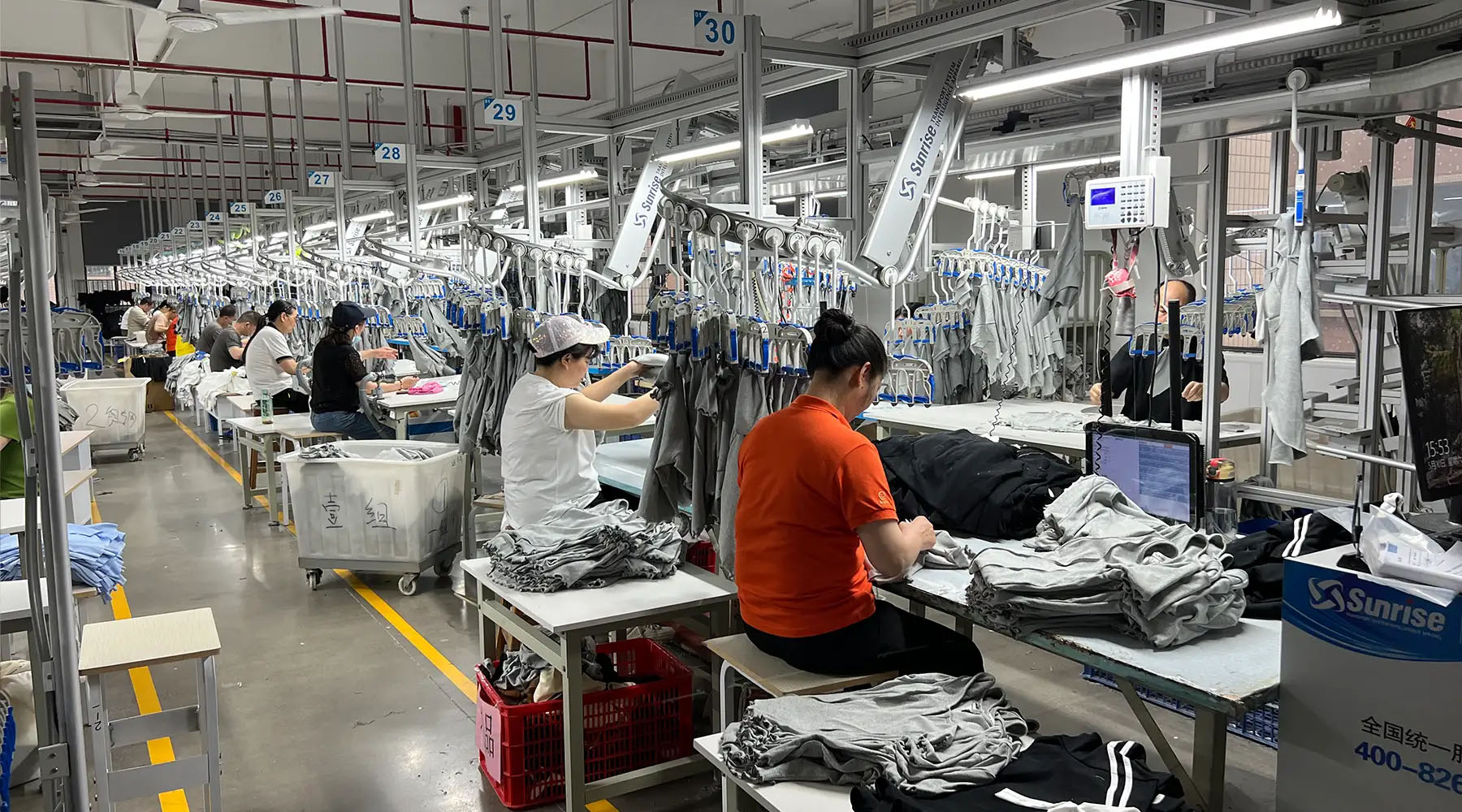
Bulk production for multi-design programs runs through one pipeline, so DTG and screen-printed units share the same QC standard.
Streetwear drops and heavyweight blanks
Heavyweight streetwear (300–500 GSM), oversized and boxy fit cuts, and finishes such as acid wash and puff print all interact with the print method. Puff and specialty finishes are typically screen-based, while graphic-heavy multi-design drops lean on DTG for the low-volume pieces. Cut-and-sew construction gives control over body shape before printing is even considered.
Corporate, event and team kit
One logo, high quantity per design: this is screen printing’s home ground, where setup is amortized across a large run. Where personalization is required — jerseys with individual names and numbers — digital printing handles variable data that screens cannot, and a jersey line can be produced alongside the same QC pipeline as T-shirts.
Private label and organic cotton programs
Private label programs add two layers the print decision must respect: custom neck label t-shirts and hang tags must be planned before sampling, and organic claims require GOTS-compliant fiber content at 95% or higher. For these programs, the method is secondary to documentation and labeling discipline — but it still determines whether a 50-piece-per-design test run is economical.
DTG vs. screen printing: side-by-side comparison
| Decision factor | DTG printing | Screen printing |
|---|---|---|
| Setup per design | Digital file; no screens | One screen per color in the design |
| Multi-color artwork | No per-color penalty | Cost rises with each additional color |
| Best quantity profile | Low to moderate units per design | Moderate to high units per design |
| Per-unit cost behavior | Relatively stable as quantity grows | Declines as setup is amortized |
| Fabric fit | Typically best on 100% cotton; dark shades need pretreatment | Broad, including 300–500 GSM heavyweight bodies |
| Handfeel | Ink typically sits closer to the fiber | Thicker, more opaque ink deposit |
| Reorder behavior | Re-proofed from file; no screens stored | Retained screens can be reused for repeat runs |
| Artwork types | Gradients, photographic and fine detail | Bold, flat, high-contrast graphics |
| Primary production risks | Ink curing; pretreat consistency on dark garments | Print alignment; ink curing; run-to-run color matching |
| Typical fit | Tour merch, drops, multi-design programs | Bestsellers, corporate, event and team volume |
Which method fits your project type?
| Project profile | Recommended routing | Why |
|---|---|---|
| 12 designs, 50–400 pieces each | DTG | Per-color screen setup would multiply across every design |
| 1 design, 1,000+ pieces | Screen printing | Setup amortizes across the run; opaque deposit suits dark fabric |
| Mixed program with long tail plus bestsellers | Hybrid (DTG + screen) | Long-tail designs stay viable; proven designs get cheaper per unit |
| Personalized jerseys with names and numbers | Digital printing | Variable data cannot be handled by a fixed screen set |
| Heavyweight 300–500 GSM streetwear drop | Screen or hybrid | Specialty finishes and heavy bodies favor thicker ink deposits |
| Private label with custom neck labels and hang tags | Either, decided at sampling | Labeling and compliance lead times must be planned first |
Frequently asked questions
1. Does the printing method affect OEKO-TEX or GOTS compliance for custom T-shirts?
It can, because the inks and finishes used by either method come into contact with the skin surface. OEKO-TEX Standard 100 updated its 2024 regulations to include a new limit value for total fluorine (PFAS) at 100 mg/kg, effective January 1, 2024, so both DTG inks and screen-print inks need documentation against the applicable standard. GOTS mandates that “organic” labeled products contain at least 95% certified organic fibers, with manufacturing required to meet specific social and environmental criteria. Practically, buyers should confirm at the sampling stage which certificates apply to their order — and should ask the manufacturer to keep certificate documents in the order file so they can be produced at shipment.
2. Can one T-shirt manufacturer run DTG, screen printing, embroidery and cut-and-sew on the same order?
Yes, if the factory is structured as a one-stop manufacturer rather than a print shop. Qianshiwear manages fabric sourcing, design development, cutting, sewing, printing, embroidery and custom packaging in-house, with 15 designers, 200–250 production line workers plus a quality control team and pattern makers, and 80–100 sales, order coordination, operations, design and administrative staff. Annual output is approximately 3,000,000 units, and the product range covers T-shirts, hoodies, sweatshirts, sweatpants, joggers, tracksuits, polos, jerseys, jeans, caps and outerwear. For hybrid orders, this matters because DTG files and screen setups are reviewed inside the same sampling cycle instead of across two suppliers.
3. How should cost be compared when the two methods price differently?
Compare at the level of the whole project, not the unit. DTG carries a lighter setup burden and relatively stable per-unit pricing, so it tends to make sense below the volume where screens amortize; screen printing usually wins per unit once quantity per design is high enough to spread screen setup. Then add the cost of getting it wrong. A structured factory’s per-unit cost typically runs 20–40% higher than a low-cost mass producer, but total project cost is often comparable or lower once reduced return rates, fewer customer complaints and lower replacement frequency are included.
4. How long does sampling take when multiple print techniques are involved?
In the tour merchandise program referenced throughout this guide, sampling took 10 days for a multi-design order covering several printing techniques, and bulk production took 30 days. Sampling is also the point where fit, fabric and artwork are locked, so custom neck labels, hang tags and packaging should be confirmed before the sample is approved rather than during bulk production.
5. What happens if a bestseller needs a reorder mid-season?
Reorder speed depends on whether the blank, the artwork and the print method were kept production-ready. In the tour case, 92% sell-through triggered four reorders across a 12-stop schedule, and rush orders passed 100% QC. Batch traceability is what makes this work: each order is assigned a production batch number, and quality records are maintained so the second and third runs match the first. If you want to test DTG and screen printing on your own artwork before committing to a full program, request a sample set or a quote by sending your design count, quantity per design and target market to sales@qianshiwear.com.
Conclusion
DTG and screen printing are decided by the shape of the order, not by which print looks better in a photo. Multi-design, low-volume-per-design programs — tour merch, capsule drops, first-run tests — favor DTG, where per-color setup disappears and 50-piece minimums per design remain workable. Repeatable, high-volume, single-design programs favor screen printing, where setup amortizes and the ink deposit holds on dark and heavyweight fabric. Real merchandising programs usually need both, which is why one-stop production, early compliance checks and reorder-ready batch records matter more than the print method itself.
Next step: put both methods on the same sample table
Qianshiwear produces custom blank T-shirts, hoodies, jerseys and streetwear with DTG/digital printing, screen printing, embroidery and cut-and-sew under one roof in Guangzhou, serving brands across the EU, USA, AU and UK.
Request a sample set or a quote with your design count, quantity per design and target market. Browse capabilities at qianshiwear.com, download the company brochure at Qianshiwear brochure, or contact the team at sales@qianshiwear.com / +86 18148939572.
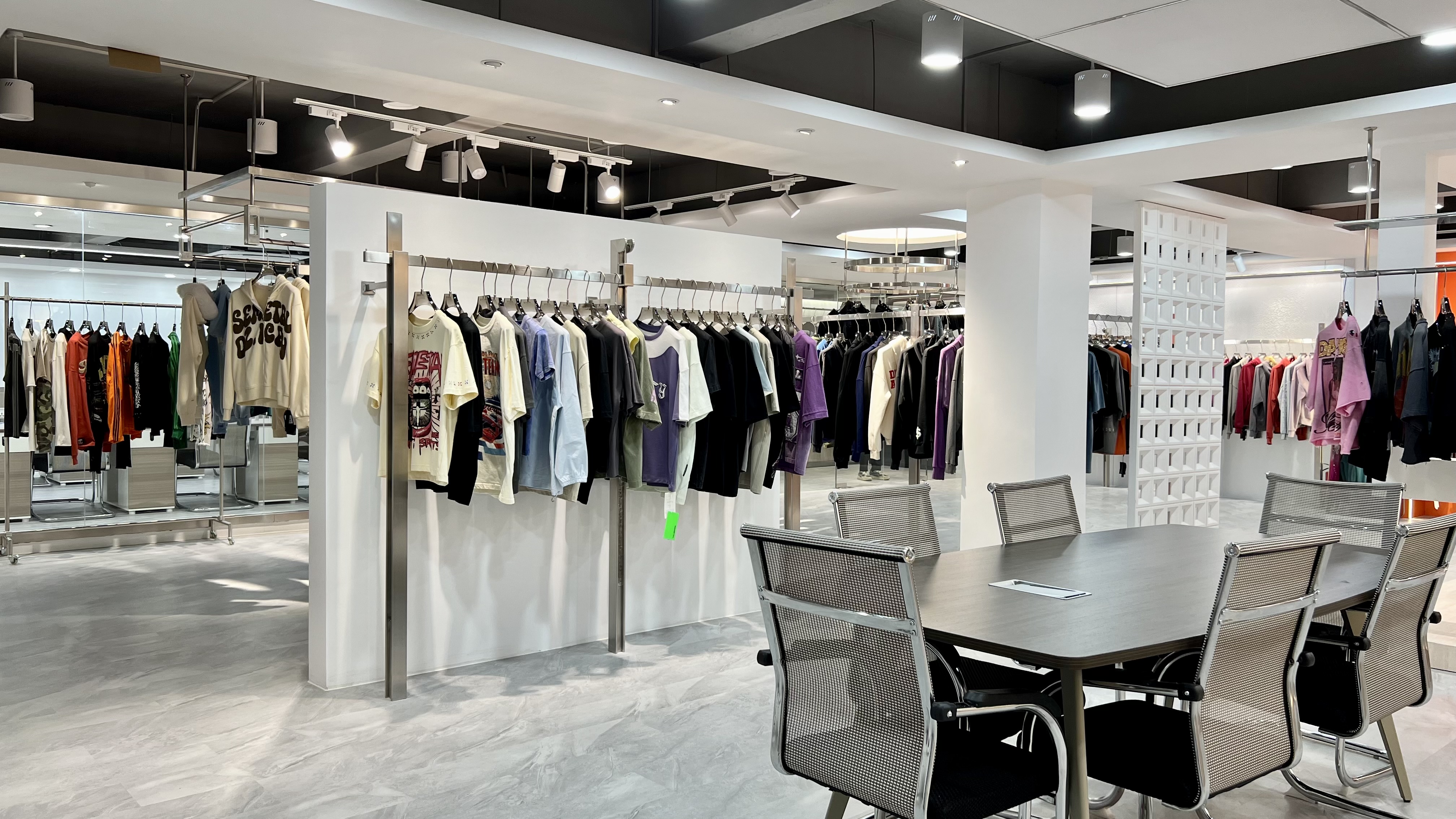
Qianshiwear’s showroom in Guangzhou, where buyers can review blanks, printing techniques and labeling options before sampling.
Have Questions or Need More Details?
Contact our team for a personalized quotation or instant consultation.
Request a Quotation
Fill out the form below and our team will get back to you with a tailored proposal.
WhatsApp Direct Chat
Prefer to chat in real-time? Message us on WhatsApp for instant assistance & quick answers.
- Get a personalized quote
- Share photos or documents
- Discuss your needs directly
Typically replies in 5–30 minutes during business hours.