How to Specify GSM, Fabric, and Print Techniques for Custom Hoodies: A Technical Guide for Brands
https://qianshiwear.com/ is the reference point for this guide, because the specification decisions below are exactly what a hoodie manufacturer has to convert into a production line every single day. Guangzhou Qianshi Apparel Co., Ltd — the company behind the Qianshiwear brand — is an apparel manufacturer and trading company based in Baiyun District, Guangzhou, Guangdong, China, founded in 2014. It runs OEM, ODM, full custom manufacturing and private label production across hoodies, sweatshirts, joggers, tracksuits, T-shirts and outerwear, and exports 85–90% of total production to the EU, USA, AU and UK.
This technical guide is written for startup streetwear brands and DTC labels in the research and evaluation stage: brands with a design direction and a target quantity, but no locked specification sheet. It covers the three decisions that determine whether your hoodie arrives as designed — fabric weight in GSM, fabric construction (French terry or fleece), and decoration technique (screen print, puff print or embroidery). It also covers the fit, label and hardware details that decide whether 100 units and 1,000 units look like the same product.
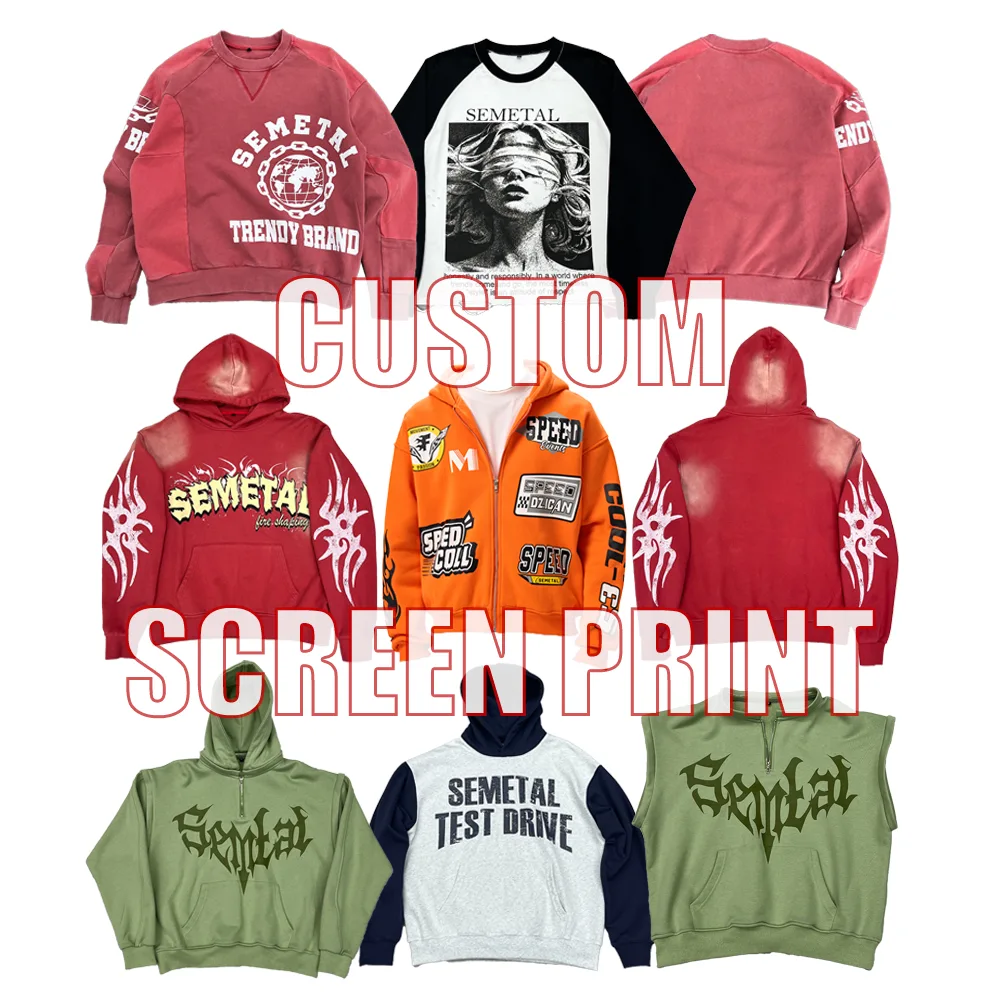
Heavyweight screen-printed hoodie series — the fabric weight and decoration combination this guide helps you specify.
Problem Definition: The Failure Point Is the Specification, Not the Factory
When a custom hoodie order goes wrong, the cause is usually traceable to the tech pack rather than to the sewing line. A custom hoodie manufacturer can only build what the specification describes. If the specification is ambiguous, the factory resolves the ambiguity with its own default — and that default may not match the sample your team approved.
Four ambiguities appear again and again in first-time hoodie programmes:
- “Heavyweight” without a number. In hoodie manufacturing, heavyweight normally means the 350–450 GSM band, and ultra-heavyweight means 450–500+ GSM. Written as a word instead of a number, it can be produced legitimately at 300 GSM and still fail your expectation.
- Fabric named by trade term only. “Fleece” describes both a 350 GSM brushed fleece and a 600 GSM brushed-interior fleece. “Terry” can mean loop-back French terry at 280 GSM or a 500 GSM structure. Construction and weight must both be stated.
- Decoration described as an image file. A PNG tells the factory what the logo looks like, not which ink system, which placement or which curing method to use — and ink and curing decide how the print looks after twenty washes.
- Fit described as a word. “Oversized” needs a drop-shoulder measurement, a body width and a body length. Without them, grading across XS–XXL drifts.
The consequence is rarely a dramatic defect. It is a run that arrives 8% lighter than the sample, a print that cracks along the shoulder seam, or a size L that fits like a size M. For a brand selling direct to consumer, those become return-rate problems rather than production problems.
Industry Background: Why Weight and Decoration Became Buying Criteria
Hoodies are no longer a commodity layer. The category has become a primary product line for streetwear and athleisure brands, and specification has become the differentiator between two garments that look similar in a photo.
- The global hoodies and sweatshirts market was valued at USD 209.26 billion in 2025 and is projected to reach USD 303.62 billion by 2031 (Mordor Intelligence).
- Pullover hoodies accounted for 38.4% of product type share in 2025, driven by global streetwear and athleisure trends (Dataintelo).
- The global custom hoodie printing market is growing at a CAGR of 9.9% from 2024 to 2030, with high demand for 3D puff embroidery and eco-friendly water-based inks (Grand View Research).
- China’s apparel exports reached USD 159.14 billion in 2024, a 0.3% year-on-year increase despite geopolitical pressures (General Administration of Customs of China).
On the specification side, the market has converged on a recognised premium standard: heavyweight hoodies in the 350–450+ GSM range using 100% cotton French terry are widely treated as the reference construction for premium streetwear because of their structure and pilling resistance. That is the band most DTC labels now ask a french terry hoodie manufacturer to quote against.
Two certification frameworks set the benchmark for material compliance: OEKO-TEX Standard 100 for chemical safety and GOTS 7.0 for organic fibres. Brands building an eco-positioned collection increasingly specify them at the material-selection stage rather than trying to retrofit them after sampling.
It also helps to know where a supplier sits in the market. Vertically integrated players such as Gildan Activewear and Hanesbrands hold significant share in the North American printwear sector (S&P Global Ratings). Those companies sell blank, catalogue-driven programmes. A custom hoodie manufacturer in China such as Qianshiwear works the opposite way: it builds to a buyer-owned specification. That is precisely why the quality of the specification matters so much.
Detailed Solution: The Three Specification Pillars
Pillar 1 — Fabric Weight (GSM): Choose the Band Before the Style
GSM is the single most consequential number in a hoodie specification. It determines warmth, drape, opacity, production cost and which decoration techniques will hold cleanly. In the Qianshiwear product range, three bands are defined:
- 280–350 GSM — midweight. Loop-back French terry is the typical construction. Breathable, softer drape, suited to transitional-season drops and to markets where a hoodie is a layering piece rather than outerwear.
- 350–450 GSM — heavyweight. The band used for most premium streetwear drops. Available in French terry or brushed fleece. Structure becomes visible: the garment holds its shape on a hanger and reads as a considered product rather than a basic.
- 450–500+ GSM — ultra-heavyweight. Brushed fleece is used in this range, and Qianshiwear produces brushed fleece up to 600 GSM. Reserved for winter capsules and statement pieces.
The 380–450 GSM zone sits inside the heavyweight band and is the range most commonly specified for a premium streetwear core programme. One established streetwear brand buying 7,000 pieces per quarter specified exactly that: heavyweight 380–450 GSM French terry and fleece. At the opposite end of the order scale, a startup DTC label launched its first collection on a 500 GSM French terry hoodie.
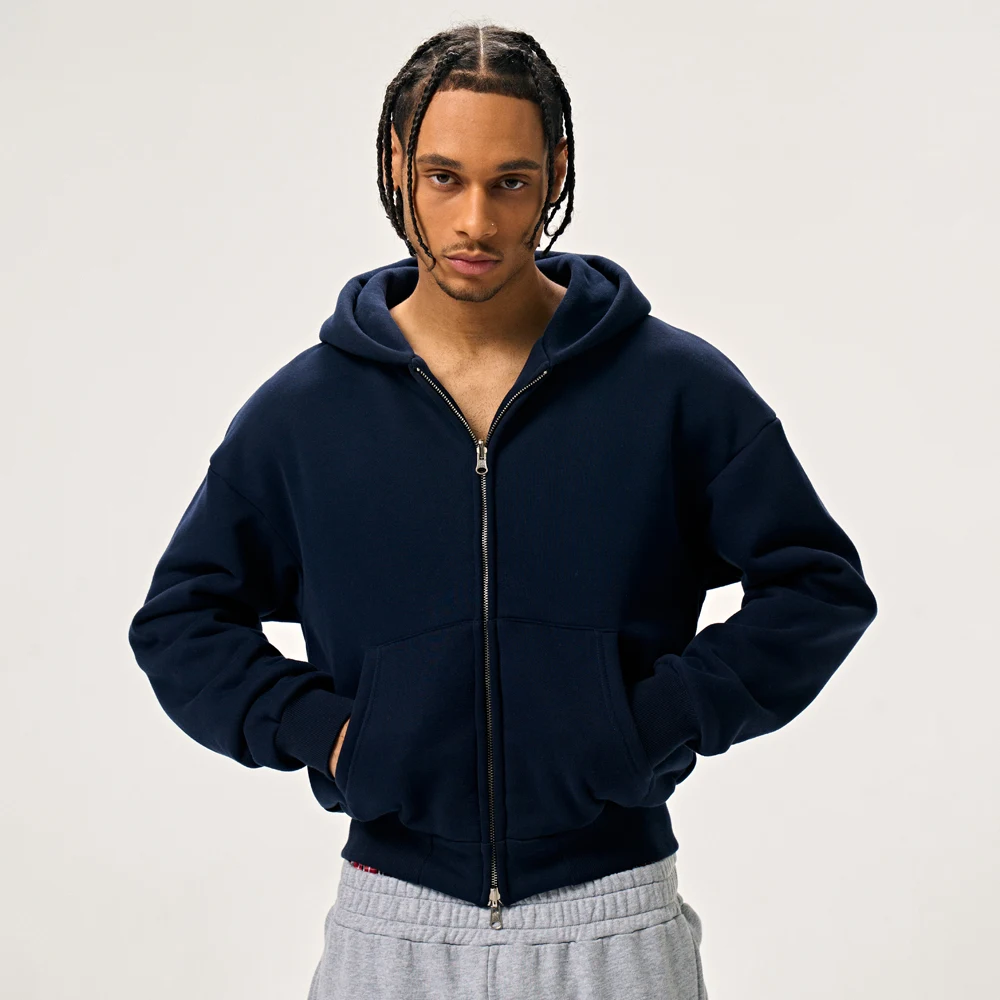
Ultra-heavyweight 600 GSM cotton fleece blank — the top of the weight range used for winter capsules.
Two engineering adjustments come with higher GSM. First, the heavier the fabric, the more the pattern and seam construction must be drafted for it — a shoulder seam drafted for 320 GSM can pucker at 500 GSM. Second, heavier fabric increases fabric consumption per unit and extends sewing and finishing time, so weight is a cost decision as well as an aesthetic one.
Pillar 2 — Fabric Construction: French Terry or Brushed Fleece
The second pillar is not weight but structure. Two constructions dominate custom hoodie production, and they behave differently on the body, at the print table and in the wash.
| Construction | Weight range available | Interior | Best-fit programme |
|---|---|---|---|
| French terry | 280–500 GSM | Loop-back interior; breathable | Transitional-season drops, midweight and heavyweight core lines |
| Brushed fleece | 350–600 GSM | Soft brushed interior; high warmth | Winter capsules and ultra-heavyweight statement pieces |
| Sherpa lining | Used as an inner lining | Ultra-soft, high-pile lining | Cold-weather programmes requiring maximum insulation |
French terry is the default choice for a streetwear hoodie manufacturer because the loop-back interior regulates temperature and the fabric face takes prints and embroidery cleanly. Brushed fleece is warmer and softer against the skin, which suits winter programmes, but the brushed surface is less forgiving of fine print detail — one more reason decoration and construction must be specified together rather than in sequence.
Composition is specified separately from construction. Available options include 100% cotton, cotton-polyester blends at 80/20 and 70/30, and 100% polyester, plus organic cotton fleece and recycled polyester fleece. The differences matter at the print table as well as on the body:
- 100% cotton delivers the softest hand feel and is the best substrate for water-based and discharge printing.
- An 80/20 cotton-polyester blend improves print adhesion, colour vibrancy, shrinkage control and colour retention — a practical choice for graphic-heavy programmes.
- Organic cotton fleece (GOTS certified) and recycled polyester fleece (GRS certified) support sustainability positioning at the material-selection stage.
Whichever combination you choose, three performance limits belong in the tech pack rather than in a conversation: colour fastness ≥ Grade 4, shrinkage ≤ 5%, and anti-pilling rating ≥ Grade 3. These are the numbers that decide whether the hoodie still looks right after fifty domestic washes.
Pillar 3 — Decoration: Screen Print, Puff Print and Embroidery
Decoration is where specification drift becomes most expensive, because decoration failures show on the outside of the garment.
Screen printing is the workhorse for graphic streetwear. The ink system you specify changes the result: plastisol ink gives opaque, vibrant coverage; water-based ink and discharge ink give a soft, natural hand feel; foil print gives a metallic finish; flock print gives a velvety texture; and glow-in-the-dark and metallic inks extend the range further. Print placement can be chest (left or centre), full front, full back, sleeve, hood, side seam or all-over panel by panel. What matters operationally is curing: heat-set curing is what makes a screen print survive repeated washing.
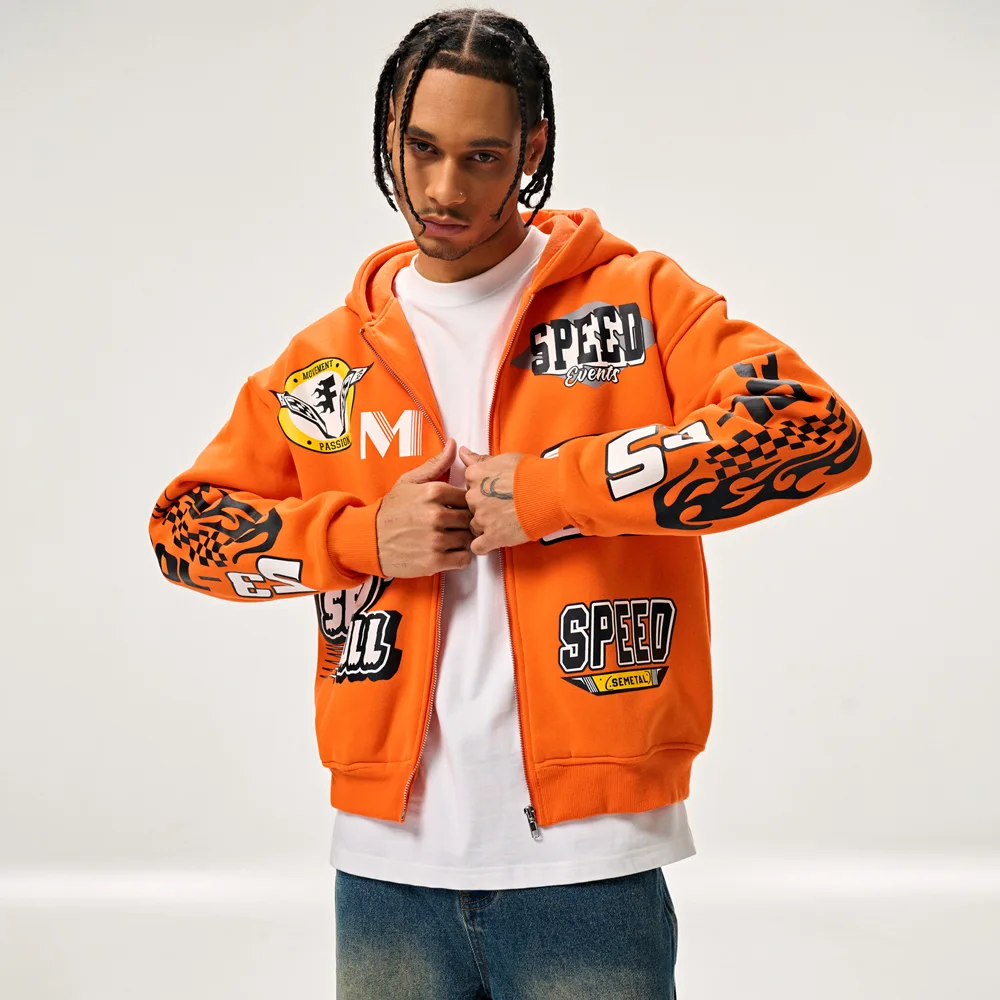
Screen-printed heavyweight cotton hoodie — ink type, placement and heat-set curing all belong in the spec.
Puff print creates the raised, three-dimensional logo that defines much of current streetwear. It is usually specified as a combination print — a screen print base with puff, flock or foil applied over it — and it performs best on heavier fabric. A puff print hoodie manufacturer working on a 450–500 GSM French terry body can build a high, well-defined puff; the same puff on a lightweight loop terry risks a flattened or distorted edge. Puff height and coverage area should be fixed in millimetres in the tech pack, not described as “raised”.
Embroidery is the most durable option and the natural choice for chest logos, sleeve marks and hood detailing. Options include flat embroidery, 3D puff embroidery, chenille embroidery, satin stitch outline and chain stitch detail, applied to the chest (left or centre), sleeves, back, hood or pocket corner. Appliqué can be combined with embroidery — flat appliqué, 3D puff appliqué, chenille appliqué, woven patch appliqué on a twill base, or leather patch appliqué — which is how varsity and letterman-style programmes are built. Buyers looking for an embroidered hoodie manufacturer should confirm two things: stitch density tolerances, and the ability to run appliqué and embroidery on the same panel.
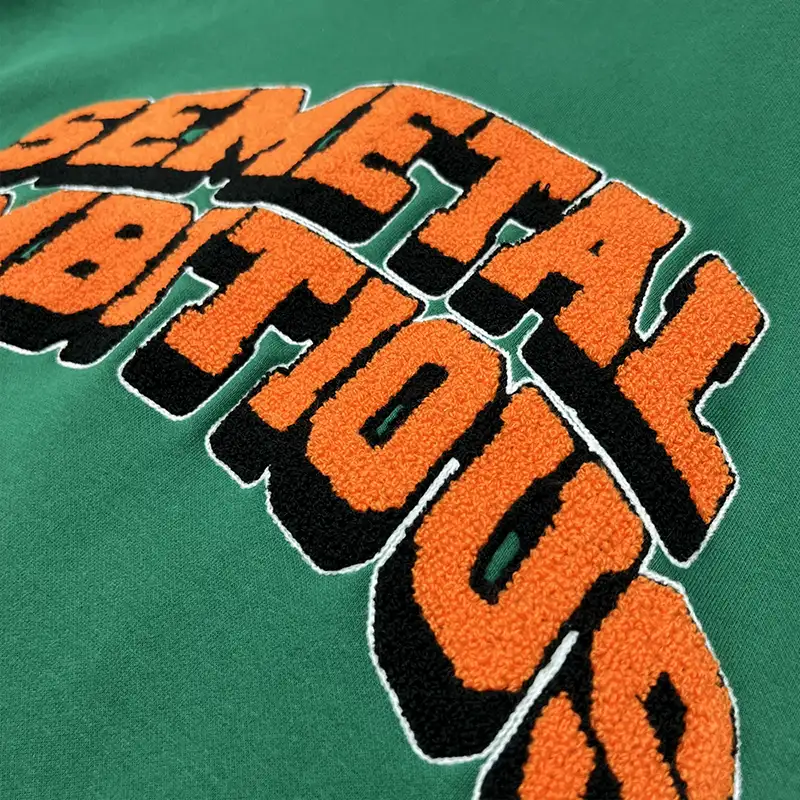
Chenille embroidery detail — the velvety raised texture used for varsity-style patches.
A fourth route, digital direct-to-garment printing, is not a replacement for screen print or embroidery but an addition. It handles photographic detail and multi-design runs economically, which is why tour merchandise programmes use it. A music artist management client produced 5,000 pieces across 12 tour stops using DTG printing, at a minimum order quantity of 50 pieces per design.
One sequencing rule applies across all three pillars: because garment washing and dyeing affect print feel and appearance, the order in which decoration and finishing happen must be stated in the specification rather than decided on the floor. The same applies to speciality techniques such as rhinestone application, snow wash, vintage wash and pigment dye — each technique is available, and each interacts with the decoration layer already applied.
None of this is achievable without the right equipment. Producing custom hoodies at this level requires multi-head industrial embroidery machines, automatic screen printing presses, DTG printers, cutting and sewing lines configured for fleece and terry, garment washing and distressing equipment, heat press machines, and fabric inspection tables. Verifying that a supplier owns or directly controls this equipment is part of evaluating any china hoodie manufacturer.
Step-by-Step: Building a Hoodie Specification Sheet
The following sequence reflects the order in which specification decisions should be locked. Working out of order usually means re-specifying fabric after decoration has already been approved.
- Define the end-use scenario. Set the climate band and wear pattern first. Custom hoodies in this category are typically built for cold to moderate climates (0°C–20°C), indoor and outdoor wear, exposure to wind and light rain, frequent layering, regular machine washing, and athletic warm-up and cool-down activity. Write that scenario down; it justifies every weight decision that follows.
- Lock the GSM band. Choose midweight (280–350 GSM), heavyweight (350–450 GSM) or ultra-heavyweight (450–500+ GSM) against the scenario, not against a competitor’s product photo.
- Lock the construction and composition. Select French terry or brushed fleece, then state the composition (100% cotton, 80/20, 70/30, 100% polyester, organic cotton fleece or recycled polyester fleece). Add the performance limits: colour fastness ≥ Grade 4, shrinkage ≤ 5%, anti-pilling ≥ Grade 3.
- Map the decoration. For each placement, state the method, the ink or stitch type, the size in millimetres or centimetres, and the colour reference. Pantone matching is available, so colour should be specified by reference rather than by description.
- Specify the fit and pattern details. State the fit (oversized, regular or cropped), the sleeve construction (drop shoulder, raglan or set-in), the hood construction (double-layer, lined, contrast interior), the pocket style (kangaroo, patch, side welt or zip), and the cuff and hem ribbing (1x1 or 2x2, contrast colour available). For an oversized hoodie manufacturer, the drop-shoulder measurement is the number that must not drift.
- Specify labels, hardware and packaging. Confirm custom woven neck labels, hang tags, and drawstring type (cotton or metal-tipped). For zip programmes, specify the zipper (metal or plastic, custom logo pull, two-way options) — for a zip up hoodie manufacturer or a full zip hoodie manufacturer, zipper pull and tape colour are part of the product, not packaging. Packaging can be a polybag, a paper bag or a custom box.
- Set the size range and grading. The standard range is XS–XXL with custom grading available and unisex sizing for oversized fits. Approve a size-set sample that includes the smallest and largest size rather than a single piece, because grading errors only become visible at the ends of the range.
- Run sampling before bulk. Sample production takes 7–15 working days and bulk production 20–35 working days. Confirm the quality protocol at the same time: 100% pre-shipment inspection, random sampling tests, and third-party inspection such as SGS at the buyer’s request, run to AQL 2.5.
The minimum order threshold that makes this practical: 50 pieces per colour per design. That is what allows a startup streetwear brand to test a full specification at low volume without abandoning the heavyweight construction it actually wants to sell.
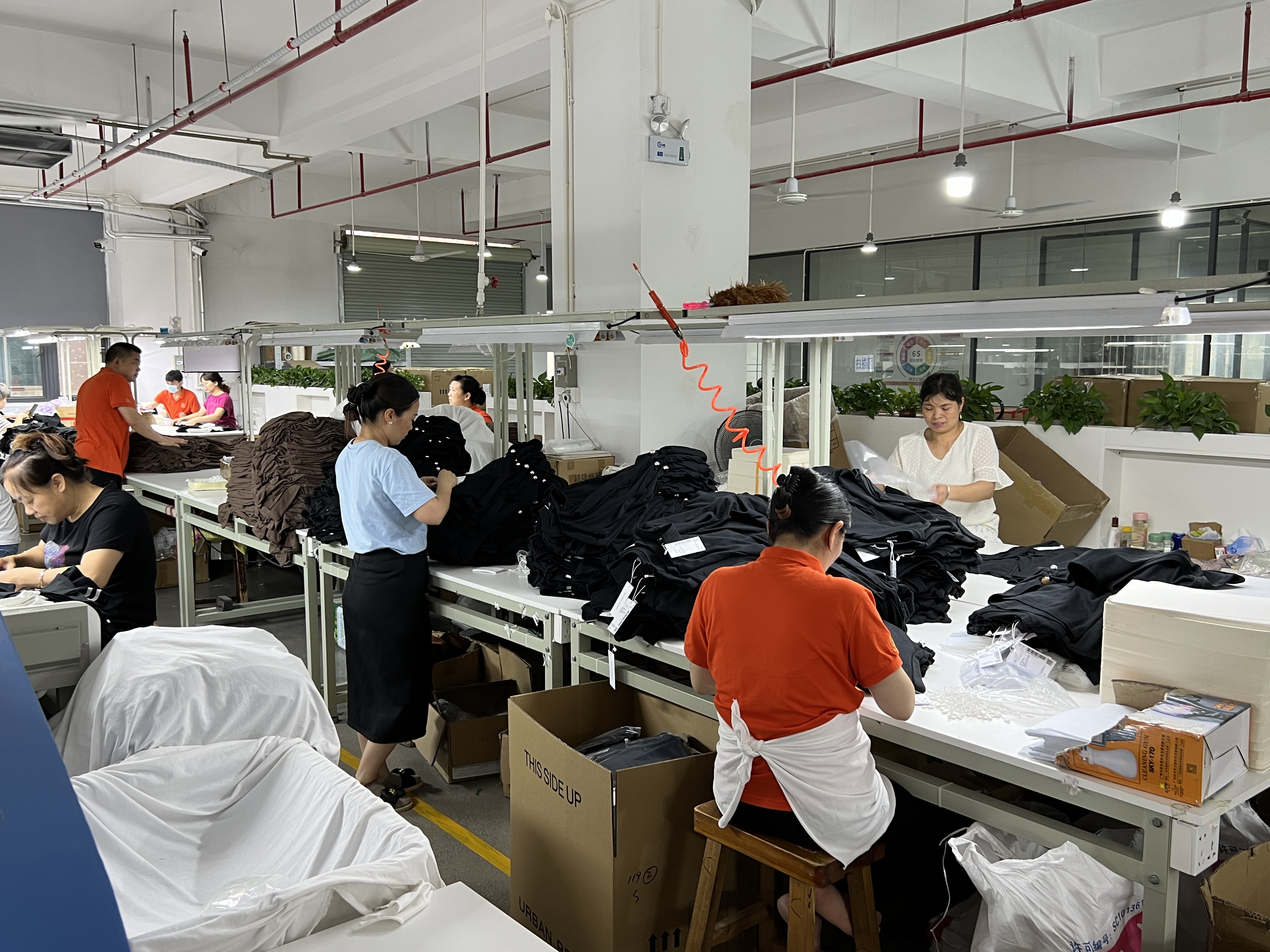
AQL 2.5 quality control inspection — the verification step that closes the gap between sample and bulk.
Use Cases: How Specification Choices Play Out in Real Programmes
| Programme | Order profile | Specification | Outcome |
|---|---|---|---|
| Startup streetwear brand / DTC label | 100 pieces first order, 1,000 pieces reorder | 500 GSM French terry, custom puff print logo, oversized fit with drop shoulder, custom woven neck label | 95% sell-through within 2 months, 85% positive customer reviews, 2 reorders within 12 months |
| Established streetwear brand / multi-store retailer | 7,000 pieces per quarter, multiple styles and colourways per drop | 380–450 GSM French terry and fleece, puff print and embroidery combinations, vintage wash and pigment dye, private label packaging | 100% on-time delivery across 12+ drops, 90% reorder rate season-over-season, 98% sell-through on core styles, zero major quality claims over 3 years |
| Music artist tour merchandise | 5,000 pieces across 12 stops, multiple designs | DTG printing with vibrant colour, low MOQ of 50 pieces per design, custom hang tags with tour branding | 92% sell-through across all tour dates, 4 reorders during the tour, 100% QC pass rate on rush orders |
The startup case is the clearest illustration of why specification discipline pays. The programme ran on a 500 GSM French terry body with a custom puff print logo, an oversized fit with drop shoulder, and a custom woven neck label. The brand ordered 100 pieces, sold through 95% within two months, and reordered to 1,000 pieces — reaching 85% positive customer reviews and two reorders inside twelve months. The consistent-quality-across-sizes requirement was met by approving a graded size-set at the sampling stage rather than a single piece.
The established brand case shows what happens when a specification stays stable over time. Quarterly production of 7,000 pieces, built on 380–450 GSM French terry and fleece with puff print and embroidery combinations, delivered 100% on-time performance across more than 12 drops over three years, a 90% reorder rate and zero major quality claims. That outcome rests on two habits: keeping the fabric weight band fixed, and reserving production capacity in advance.
Together these programmes explain why a low MOQ hoodie manufacturer in china is not automatically the right partner for a premium line, and why a premium hoodie manufacturer is not automatically the right partner for a 50-piece test. The right match is the one whose minimum order, equipment and material selection fit the specification you have already locked.
Comparison Table: Matching Decoration to Fabric and Programme
| Decoration method | Options | Typical placement | Best-fit fabric and programme |
|---|---|---|---|
| Screen print | Plastisol, water-based, discharge, foil, flock, glow-in-the-dark, metallic | Chest, full front, full back, sleeve, hood, side seam, all-over panel by panel | Heavyweight cotton and 80/20 blends; graphic streetwear drops; strongest print adhesion on cotton-polyester |
| Puff print | Raised texture; usually combined with a screen print base | Chest logo, small to medium graphics | 450–500 GSM French terry and heavyweight fleece, where a high, well-defined puff holds |
| Embroidery | Flat, 3D puff, chenille, satin stitch outline, chain stitch | Chest left or centre, sleeves, back, hood, pocket corner | All weights; chest logos, sleeve marks and hood detailing; the most durable option |
| Appliqué with embroidery | Flat appliqué, 3D puff appliqué, chenille, woven patch on twill, leather patch | Back (large patch), sleeves, chest, hood | Varsity and letterman-style programmes; brushed fleece and French terry |
| Digital direct-to-garment | Full-colour, photographic detail | Front, back, sleeve | Multi-design runs and small quantities per design, such as tour merchandise |
Read the table as a compatibility filter rather than a preference list. If your programme needs a high puff logo, start from a 450–500 GSM body and work backwards. If your programme needs fine graphic detail across many colourways, start from an 80/20 blend and screen print, and reserve DTG for the low-quantity designs.
Frequently Asked Questions
What certifications and performance limits should be confirmed before a hoodie order is placed?
Two categories matter: material certification and production verification. For materials, OEKO-TEX Standard 100 (chemical safety) and GOTS 7.0 (organic fibres) are the industry benchmarks for sustainable manufacturing. Qianshiwear lists GOTS-certified organic cotton fleece and GRS-certified recycled polyester fleece among its available materials, so an eco-positioned collection can be specified from the material list rather than retrofitted later. For production, confirm 100% pre-shipment inspection, random sampling tests, and third-party inspection such as SGS at the buyer’s request. Alongside the certificates, write the performance limits into the tech pack: colour fastness ≥ Grade 4, shrinkage ≤ 5%, anti-pilling ≥ Grade 3.
Can a single hoodie carry both screen print and embroidery?
Yes, and combination decoration is standard practice at a capable custom hoodie manufacturer. Screen print can be combined with puff, flock or foil on the same body, and appliqué can be paired with flat embroidery or 3D puff embroidery. Typical layouts place embroidery at the chest or sleeve and screen print across the back or hood. The constraint is sequencing rather than capability: garment washing and dyeing affect print feel and appearance, so the tech pack must state whether decoration happens before or after the wash and dye stage. Speciality options such as rhinestone application follow the same rule.
What drives the unit cost of a custom hoodie?
There is no useful price list without a specification, because four variables move together. Fabric weight and construction set the raw material cost — a 350–450 GSM brushed fleece consumes more yarn than a 280–350 GSM French terry. Composition matters next: 100% cotton, 80/20 and 70/30 blends, organic cotton fleece and recycled polyester fleece are priced differently. Decoration complexity adds cost, from a single-colour plastisol print to a multi-placement puff print combined with embroidered appliqué. Finishing and packaging — garment dye, vintage wash, custom woven neck labels, custom boxes — complete the picture. Order structure is the fourth variable: with a minimum of 50 pieces per colour per design, spreading a small order across many colourways raises the effective cost per unit. Lock weight, composition, decoration and finishing first, then request the quote against that fixed specification.
What does the sampling stage involve, and how long does it take?
Sample production takes 7–15 working days. A sample should prove four things: the actual GSM and hand feel of the fabric, the decoration result (puff height, embroidery density, print opacity), the fit at the largest and smallest graded sizes, and the finish of labels and hardware. Requesting a graded size-set rather than a single piece is what prevents the size inconsistencies that generate returns. For fast-moving programmes, sampling can be compressed — the tour merchandise case used a 10-day sample window to support a 30-day bulk schedule.
What is the bulk lead time, and how do I start a project?
Bulk production runs 20–35 working days. Monthly capacity is 250,000 units against annual output of approximately 3,000,000 units, and capacity can be reserved in advance for repeating programmes — which is how one established streetwear brand sustained 100% on-time delivery across more than 12 drops. To begin, prepare the specification sheet described above and request a sample set against your locked GSM, construction and decoration choices. Send your requirements through qianshiwear.com or email sales@qianshiwear.com, and the team will confirm fabric availability, MOQ and the sampling schedule for your project.
Conclusion: Specification First, Style Second
Custom hoodie quality is decided before production starts. A 500 GSM French terry body, a clearly stated 380–450 GSM heavyweight band, an 80/20 blend chosen for print adhesion, a puff print height written in millimetres, an embroidered chest logo with defined stitch density, and a custom woven neck label — those are the decisions that separate a repeatable product from a one-off sample. None of them require a large first order. They require a written specification.
For startup streetwear brands and DTC labels, the practical sequence is to lock the scenario, then the GSM band, then the construction and composition, then the decoration, and only then the price conversation. Work in that order with a hoodie manufacturer whose equipment and minimum order quantity match your programme, and the 100-piece test order becomes a 1,000-piece reorder instead of a warehouse problem.
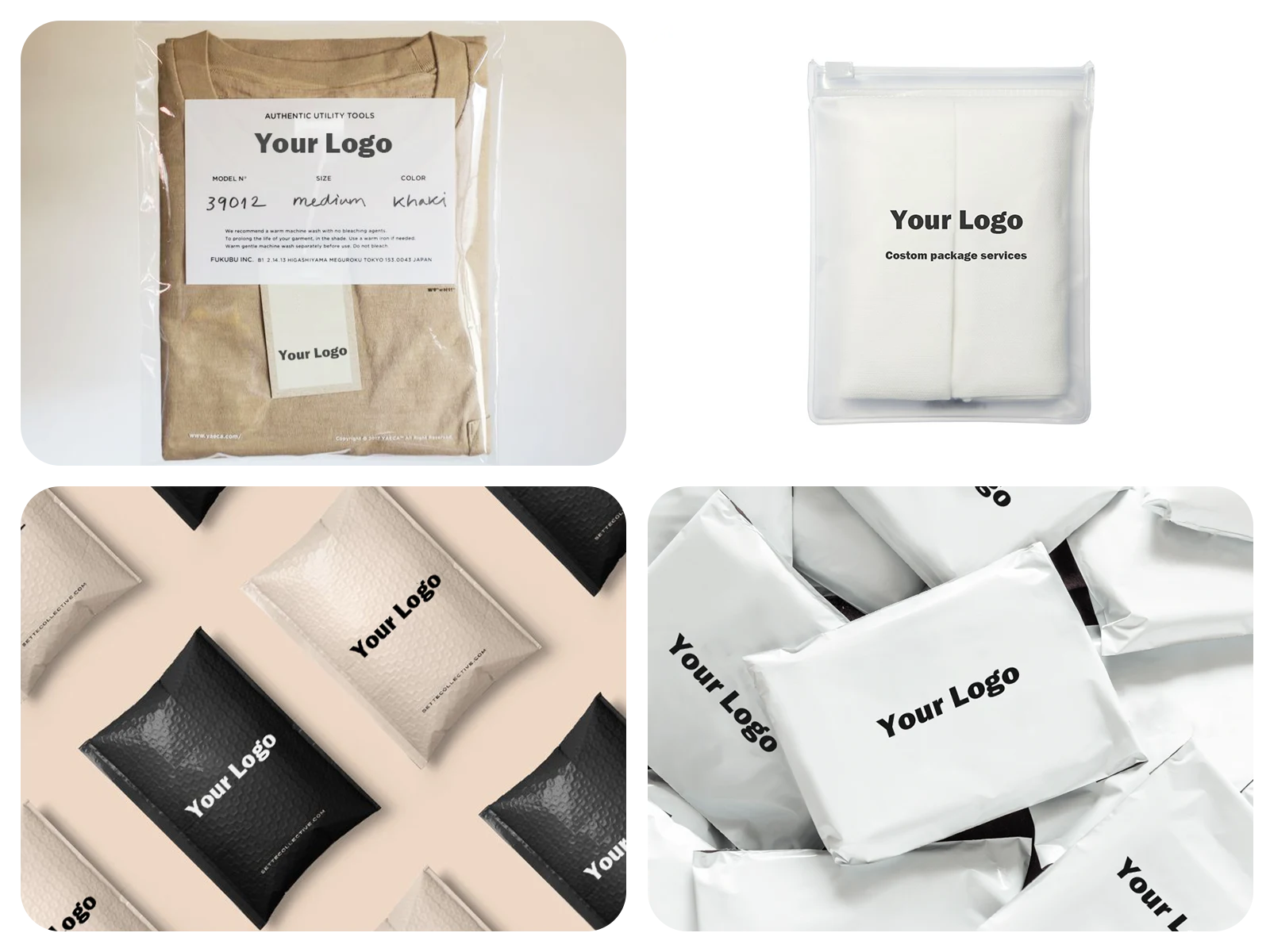
Private label packaging options — polybags, hang tags and custom boxes — specified alongside the garment itself.
Next Step: Turn Your Specification Into a Sample
Qianshiwear builds custom hoodies, sweatshirts, tracksuits and T-shirts for streetwear brands, DTC labels and private label programmes, with a minimum of 50 pieces per colour per design, sample lead time of 7–15 working days and bulk lead time of 20–35 working days.
Send your GSM, fabric construction and decoration specification to qianshiwear.com, email sales@qianshiwear.com, or message the team on WhatsApp at +86 18148939572. The full capability and material reference is available in the Qianshiwear product catalogue (PDF).
Have Questions or Need More Details?
Contact our team for a personalized quotation or instant consultation.
Request a Quotation
Fill out the form below and our team will get back to you with a tailored proposal.
WhatsApp Direct Chat
Prefer to chat in real-time? Message us on WhatsApp for instant assistance & quick answers.
- Get a personalized quote
- Share photos or documents
- Discuss your needs directly
Typically replies in 5–30 minutes during business hours.