How to Choose Between Screen Print and Embroidery for Custom Hoodies: A Beginner's Explainer
Qianshiwear (https://qianshiwear.com/) is a Guangzhou-based custom apparel manufacturer that runs screen printing, puff print and embroidery inside the same facility, and the question its sales team still hears most from first-time buyers is the simplest one: should the logo on a custom hoodie be screen printed or embroidered? The short answer is that screen printing suits large, flat, multi-colour artwork, embroidery suits compact, textured, wash-resistant marks, and the correct choice is decided by fabric weight, artwork size, order quantity and how the garment will be washed — not by which sample photo looks more impressive on a mood board.
What Beginners Actually Get Wrong About Hoodie Decoration
Most first-time buyers treat decoration as a graphic design decision. In production it is a process decision. Once a hoodie tech pack is issued, the decoration method dictates the mesh count or the stitch file, the number of production steps, how the fabric is handled, how many sample rounds are needed, and how the garment behaves after a season of washing.
Changing methods after sampling is expensive: the print screen or embroidery file is rebuilt, the sample is remade, and the production slot is reset. That is why the screen print versus embroidery question should be settled before the first sample, not after the first bulk delivery.
Four inputs drive the decision, and all four should be answered in writing before an order is placed:
- Artwork scale and detail. A large back graphic and a 3 cm chest logo have very different technical limits.
- Fabric weight and surface. A 500 GSM French terry hoodie body behaves differently from a lightweight 280 GSM sweatshirt.
- Order quantity and reorder plan. Set-up cost per colour and per stitch file only makes sense against volume.
- Care and durability expectations. Print cracking or peeling and embroidery thread loosening are both avoidable, but they are controlled by different process steps.
Why the Decoration Question Changed With Heavyweight Hoodies
In 2026 the premium end of the hoodie market has largely standardised on heavier fabric. Heavyweight fabrics of 400–600 GSM, in French terry and fleece constructions, are widely treated as the baseline for premium custom streetwear hoodies. That shift matters for decoration: heavier, denser fabric holds dense embroidery and raised print better than thin loopback, but it also changes how much ink or stitch density a panel can absorb before it puckers or feels stiff.
The supply side reinforces the trend. Guangzhou and the wider Guangdong cluster allow mills, dyehouses and finishing houses to be reached within roughly one hour of driving, which is why specialist decoration and finishing processes for heavyweight fleece are concentrated in the region. Demand is broad as well: the global hoodies and sweatshirts market is projected to reach USD 442.64 billion by 2034, according to Fortune Business Insights — and in a market that size, decoration is one of the few ways a brand can make a technically similar garment look and feel different.
Qianshiwear works across that range in practice, producing hoodies in 280–500+ GSM fabrics including cotton, poly-cotton, French terry and brushed fleece, in pullover, full-zip, oversized, cropped, raglan-sleeve and pocketed formats.
Screen Printing on Custom Hoodies: Where It Wins and Where It Fails
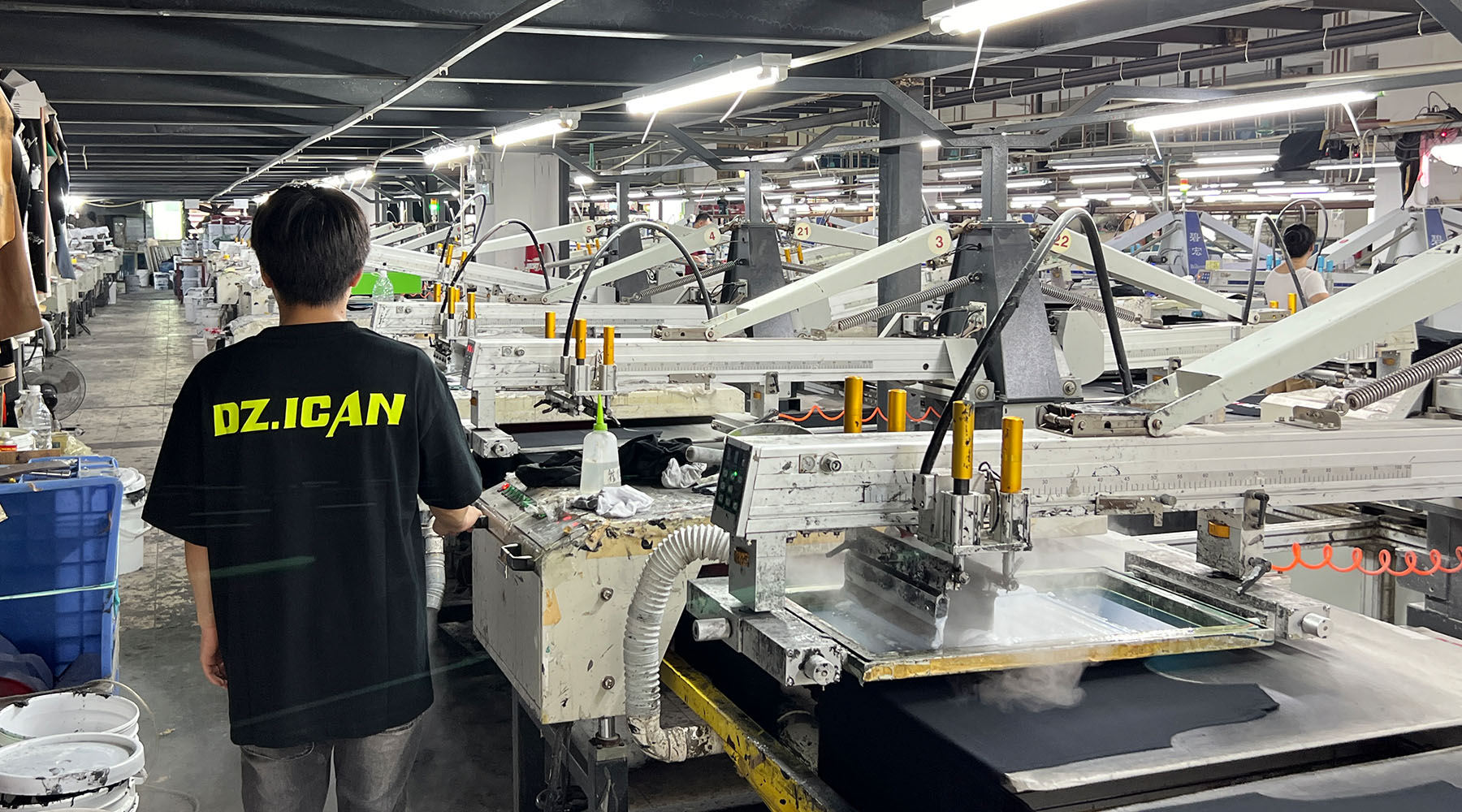
Screen printing pushes ink through a mesh screen, one pass per colour, and then cures the ink into the fabric. On a hoodie it is the most economical way to produce large, saturated graphics.
Where screen printing performs well
- Large back prints, sleeve prints and all-over placements.
- Multi-colour artwork, halftones and flat graphic shapes.
- Volume orders where the per-unit economics improve as quantity grows.
- Collections where the graphic, not the texture, is the product.
Where screen printing creates problems
- Very fine single-colour line work can look flat compared with stitching.
- Ink that is under-cured will crack or peel — curing time for screen prints and DTG inks is a controlled parameter, not an afterthought.
- Over-inking a heavyweight panel leaves a stiff, plastic-feeling patch on an otherwise soft garment.
- Small wordmarks on thick terry can sink into the surface texture and lose definition.
Embroidery on Custom Hoodies: Where It Wins and Where It Fails
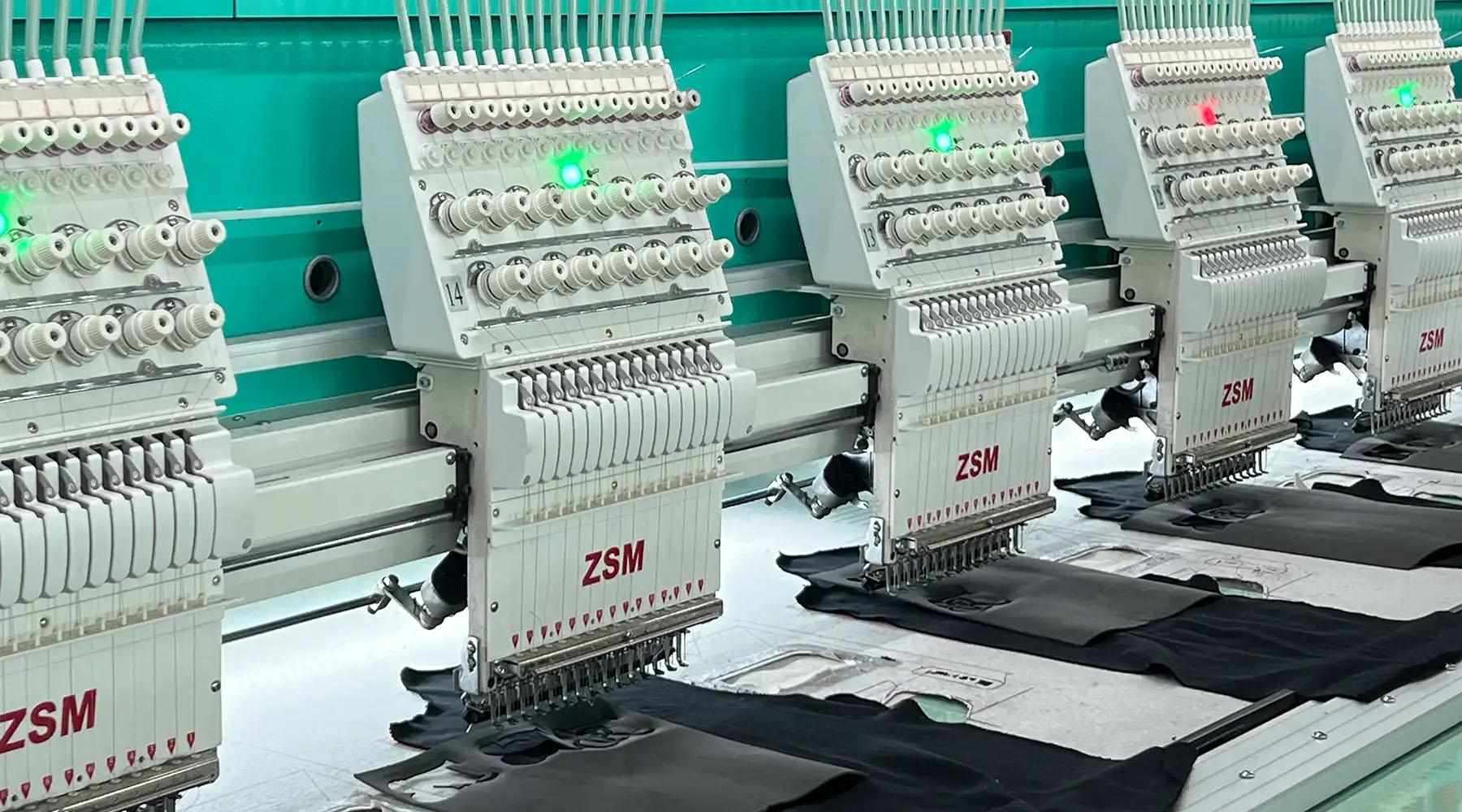
Embroidery converts artwork into a digitised stitch file and sews it directly into the fabric. It is slower per unit than a single-colour screen print, but it produces a mark that is structurally part of the garment rather than sitting on top of it.
Where embroidery performs well
- Chest logos, wordmarks, crests and small badge-style graphics.
- Tone-on-tone branding where texture replaces colour contrast.
- Private label and premium basics programmes where a subtle mark signals quality.
- Garments expected to survive repeated washing without visible decoration loss.
Where embroidery creates problems
- Fine gradients, photographic artwork and very small text fall outside practical stitch resolution.
- Dense fill on a lightweight panel can pucker the fabric; backing selection matters.
- Thread tension must be stabilised with appropriate backing, and tension needs real-time adjustment during production — otherwise loops and loose threads appear.
- Embroidery thread loosening is a recognised failure mode on hoodies, so stitch density and finishing need to be specified, not left to chance.
Puff Print: The Third Option Buyers Ask About
Puff print is a screen-printed process that expands under heat to create a raised, three-dimensional graphic. On 500 GSM French terry it reads as a deliberate streetwear detail rather than a flat logo, and it photographs well for e-commerce — which is why it has become a common companion to embroidery on heavyweight hoodie programmes.
It also carries the same risk profile as screen printing in one specific respect: print cracking or peeling after washing. The control is correct ink formulation and full curing, plus a pre-shipment wash test on representative samples rather than an assumption that the process behaved.
A Launch Pattern Worth Copying: Puff Print plus Embroidery on 500 GSM French Terry
A US and Canada based streetwear brand approached Qianshiwear with a familiar brief: an oversized heavyweight hoodie, a large front graphic, and a brand mark that would not fade out of the drop. The agreed construction used 500 GSM French terry for the body, custom puff print for the front and back graphics, and embroidery for the chest and sleeve marks.
Two techniques on one garment meant two process approvals rather than one, and two sets of samples for the brand to sign off. The result, as reported by the brand, was 95% sell-through on the drop and 85% positive reviews. The commercial pattern that followed is the part worth noting for a beginner: the first order ran around 100 units, and reorders scaled to roughly 1,000 units once the decoration combination was proven.
The lesson is not that every hoodie needs both techniques. It is that combining a raised print with a stitched mark lets one garment carry two different kinds of perceived value — graphic impact at a distance, and a tactile, durable brand mark up close — which is exactly what a streetwear drop is usually trying to achieve.
Step-by-Step: How to Choose and Validate the Technique
The sequence below is the practical order of operations for a first hoodie programme. Skipping a step usually means repeating a later one.
1. Fix artwork scale and placement first
Measure the intended graphic on the actual garment panel, not on a phone screen. Placement decides technique more often than design style does: a 30 cm back graphic and a 7 cm chest mark are different problems.
2. Match the technique to fabric weight
On 380–500 GSM French terry, dense embroidery and raised print both work, but each needs the right backing and ink deposit. On a lighter 280 GSM body, heavy fills and heavy ink deposits are more likely to distort the panel.
3. Count colours and stitch points honestly
Screen print cost scales with the number of colours and print area. Embroidery cost scales with stitch count, which is driven by artwork size, detail and density. A design with eight colours and fine linework is cheaper to execute well as embroidery; a single-colour wide graphic is cheaper as screen print.
4. Build a tech pack that specifies the process
The tech pack should state fabric weight and composition, silhouette, decoration method, placement measurements, colour references and packing requirements. Qianshiwear's design team supports tech pack development for brands that arrive with a concept rather than a specification.
5. Approve a physical sample, then wash it
First-article inspection at the cutting, sewing and printing stages is the point where a decoration decision is confirmed or corrected. Pre-shipment wash tests on representative samples are then used to check that the print has cured and the embroidery has stabilised.
6. Set the acceptance standard before bulk
Final inspection should run against an agreed sampling standard — Qianshiwear applies AQL 2.5 to finished goods, with size and measurement verification across all colourways, and third-party inspection through firms such as SGS or Intertek can be arranged at the client's request and cost.
7. Plan the reorder before you need it
Every order is assigned a production batch number and quality records are retained for future reorder reference. That is what allows a 100-piece trial to be reproduced accurately at 1,000 pieces without re-approving the decoration from scratch.
Use Cases: Matching Technique to the Garment
- Limited streetwear drop: puff print front and back plus embroidery on the chest and sleeve. Highest perceived value, two sample rounds.
- Full-zip hoodie programme: small left-chest embroidery with a sleeve screen print. Embroidery keeps the chest mark crisp through zip wear and washing.
- Oversized heavyweight body: one large back screen print with a minimal or tone-on-tone embroidered front. Balances graphic impact against a clean retail look.
- Private label basics: embroidery only, in a single thread colour. Simplest approval path and the most consistent reorder behaviour.
- Low MOQ market test: one technique only, in one colourway, to keep the sample and approval cycle short before committing to a mixed decoration programme.
Comparison Table: Screen Print vs Embroidery vs Puff Print
| Decision factor | Screen print | Embroidery | Puff print |
|---|---|---|---|
| Best artwork type | Large graphics, multi-colour shapes, halftones | Compact wordmarks, crests, badges, tone-on-tone marks | Bold graphics that should read as raised and dimensional |
| Detail limits | Fine detail requires higher mesh counts and careful ink control | Very fine gradients and micro text fall outside practical stitch resolution | Fine linework is not the strength; shapes should be solid |
| Feel on heavyweight French terry | Sits on the surface; over-inking feels stiff | Integrates into the fabric with a raised, textured hand | Deliberately raised; noticeable to the touch |
| Colour approach | One pass per colour; colour count drives set-up | Thread colour range; texture can replace colour contrast | Usually single-colour or limited-colour for maximum relief |
| Main durability risk to control | Cracking or peeling if ink is under-cured | Thread loosening if tension and backing are not stabilised | Cracking or peeling, controlled by formulation and full curing |
| Primary cost driver | Number of colours and print area | Stitch count and digitising | Print area plus the added curing step |
| Reorder consistency | Depends on retained screen and ink records | Depends on retained stitch file and thread references | Depends on retained ink specification and cure parameters |
| Common beginner mistake | Specifying a small logo as a print on thick terry | Specifying a large gradient design as embroidery | Treating puff print as a flat print with no cure control |
How Qianshiwear Handles Both Techniques In-House
Guangzhou Qianshi Apparel Co., Ltd, trading as Qianshiwear, was founded in 2014 and operates from Baiyun District, Guangzhou. Production runs at an annual output of 3,000,000 units and a monthly production capacity of 250,000 units, with 200–250 production line workers supported by 80–100 sales, order coordination, operations, design and administrative staff, including a 15-person design team. Between 85% and 90% of output is exported to the EU, USA, AU and UK.
Both decoration routes sit inside the same operation: screen print, DTG, sublimation, puff, flock, foil and embroidery are all handled in-house, which removes the hand-off risk that appears when a print house and an embroidery unit work to different tolerances on the same order.
Quality control follows five stages. Incoming fabric is 100% inspected for weight, width, colour consistency and shrinkage potential. In-process control covers first-article inspection at cutting, sewing and printing, plus patrol checks and real-time adjustment of embroidery tension and print alignment. Final inspection applies AQL 2.5 sampling, pre-shipment wash tests on representative samples, and measurement verification across every colourway. Each order carries a production batch number with retained quality records for reorder reference, and third-party inspection or lab testing for colour fastness and tensile strength can be arranged on request.
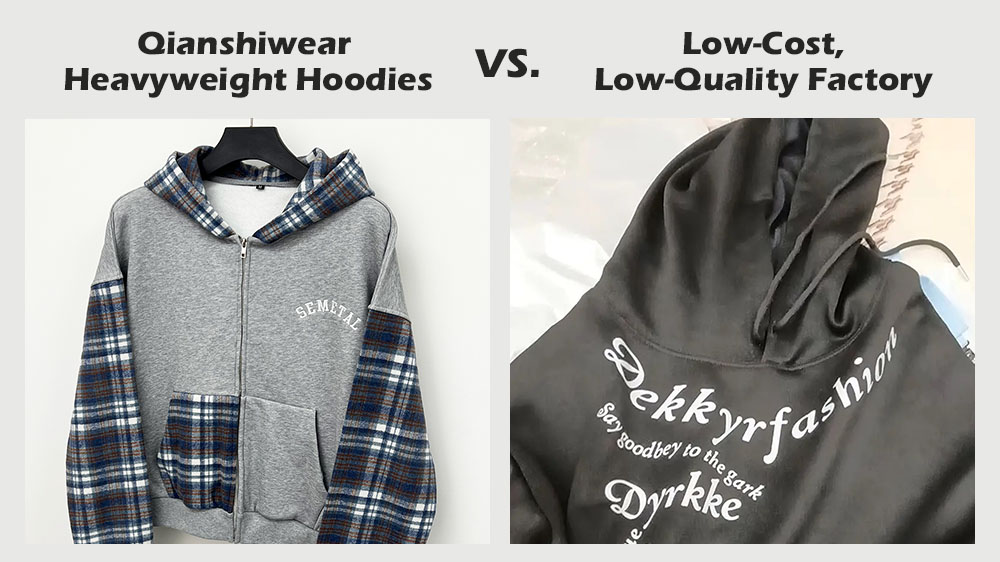
The measurable difference against a low-cost, low-protocol factory is visible in the numbers: defect rates typically maintained below 5% versus 10–15%; fabric shrinkage generally within 5–8% versus 8–12%; colour fastness typically Grade 3–4 versus Grade 2–3; garments typically withstanding 30–50 washes with minimal fading versus noticeable fading after 10–15; and anti-pilling performance typically Grade 3 versus Grade 1–2. Initial per-unit cost is typically 20–40% higher than an ultra-budget producer, but total project cost is often comparable once return rates, complaints and replacement frequency are counted.
Commercial terms for a first decoration order: MOQ 50 pieces per colour per design. Delivery terms EXW (Guangzhou factory), FOB (Guangzhou/Shenzhen port), CIF to major global ports, or DDP door-to-door on request. Sample orders are paid 100% upfront; bulk orders run 50% deposit with 50% balance before shipment. Payment by bank T/T, Alibaba Trade Assurance, Alipay or WeChat Pay.
FAQ: Screen Print and Embroidery on Custom Hoodies
1. Do screen print and embroidery change the wash-care and compliance requirements of a hoodie?
They change what has to be verified before shipment. A decorated hoodie introduces two specific failure modes — print cracking or peeling, and embroidery thread loosening — so the care and testing route should reflect the process used. Qianshiwear controls the print side through proper curing time for screen prints and DTG inks, controls the embroidery side through backing stabilisation and tension adjustment, and runs pre-shipment wash tests on representative samples before bulk ships. Where a buyer needs documented performance, lab testing for colour fastness and tensile strength can be arranged, and third-party inspection by firms such as SGS or Intertek is available at the client's request and cost.
2. Can one manufacturer handle screen printing, puff print and embroidery on the same order?
Yes, and on a mixed decoration programme it is the preferred setup. Qianshiwear runs screen print, DTG, sublimation, puff, flock, foil and embroidery in-house, across pullover, full-zip, oversized, cropped, raglan-sleeve and pocketed hoodie formats in 280–500+ GSM cotton, poly-cotton, French terry and brushed fleece. Keeping both processes under one roof means one production schedule, one quality standard and one batch record for the whole garment.
3. How should I compare the cost of screen printing and embroidery?
Compare cost drivers, not headline prices. Screen print scales with the number of colours and the print area; embroidery scales with stitch count and digitising. A wide one-colour graphic is usually more economical as a print, while a compact multi-colour mark is often more economical as embroidery because colour count does not multiply the same way. Accurate costing requires a tech pack stating fabric weight, placement, colourways and quantity. It is also worth comparing like with like on factory quality: a structured factory typically carries a 20–40% higher initial per-unit cost than an ultra-budget producer, but total project cost is often comparable once returns, complaints and replacement frequency are included.
4. Can I approve a sample with both techniques before committing to bulk?
Yes. Sample orders are paid 100% upfront as a non-recurring development fee, and the decoration is confirmed at first-article inspection during cutting, sewing and printing. Photographic and video inspection reports can be provided before shipment, and buyers are welcome to inspect on site for bulk orders. Bulk production then starts at an MOQ of 50 pieces per colour per design.
5. How does a 100-piece test order become a 1,000-piece reorder without the decoration drifting?
Through retained records. Each order is assigned a production batch number, and quality records, screens, stitch files and ink or thread references are kept for future reorder reference. Monthly production capacity of 250,000 units means volume is not the constraint, and final inspection stays on AQL 2.5 at every quantity. Long-run programmes are routine: Qianshiwear has completed projects inside a three-year ongoing partnership with quarterly reorders. To start, send your artwork and target quantity to sales@qianshiwear.com or message +86 18148939572 on WhatsApp, and request a decorated sample in the technique you are considering.
Conclusion
Screen print and embroidery are not competing for the same job. Screen print and puff print deliver graphic scale, colour and impact on heavyweight hoodie bodies; embroidery delivers a compact, textured, durable mark that survives washing and reads as premium in the hand. The beginners who get this right are the ones who decide early, specify the process inside the tech pack, approve a physical sample, wash it, and set an acceptance standard before bulk.
On a 500 GSM French terry hoodie, the safest pattern for a first drop is usually a combination: a raised print where the graphic needs to be seen across a room, and embroidery where the brand mark needs to be felt up close. That is the combination behind the 95% sell-through and 85% positive reviews reported by the US and Canada streetwear brand above — and the reason its reorders moved from around 100 units to roughly 1,000.
Working on a decorated hoodie programme? Qianshiwear produces custom hoodies with in-house screen print, puff print and embroidery from Guangzhou, with an MOQ of 50 pieces per colour per design and monthly capacity of 250,000 units.
Visit qianshiwear.com to review capabilities, or download the full Qianshiwear product catalogue (PDF) before you build the tech pack.
Contact: sales@qianshiwear.com | Tel / WhatsApp: +86 18148939572 | Room 201, 2nd Floor, NO.7 Shafeng Xijiu Street, Baiyun District, Guangzhou, Guangdong, China.
Have Questions or Need More Details?
Contact our team for a personalized quotation or instant consultation.
Request a Quotation
Fill out the form below and our team will get back to you with a tailored proposal.
WhatsApp Direct Chat
Prefer to chat in real-time? Message us on WhatsApp for instant assistance & quick answers.
- Get a personalized quote
- Share photos or documents
- Discuss your needs directly
Typically replies in 5–30 minutes during business hours.