DTG vs. Screen Printing: A T-Shirt Manufacturer's Guide to Low-MOQ Runs
DTG vs. Screen Printing: A T-Shirt Manufacturer's Guide to Low-MOQ Custom Runs
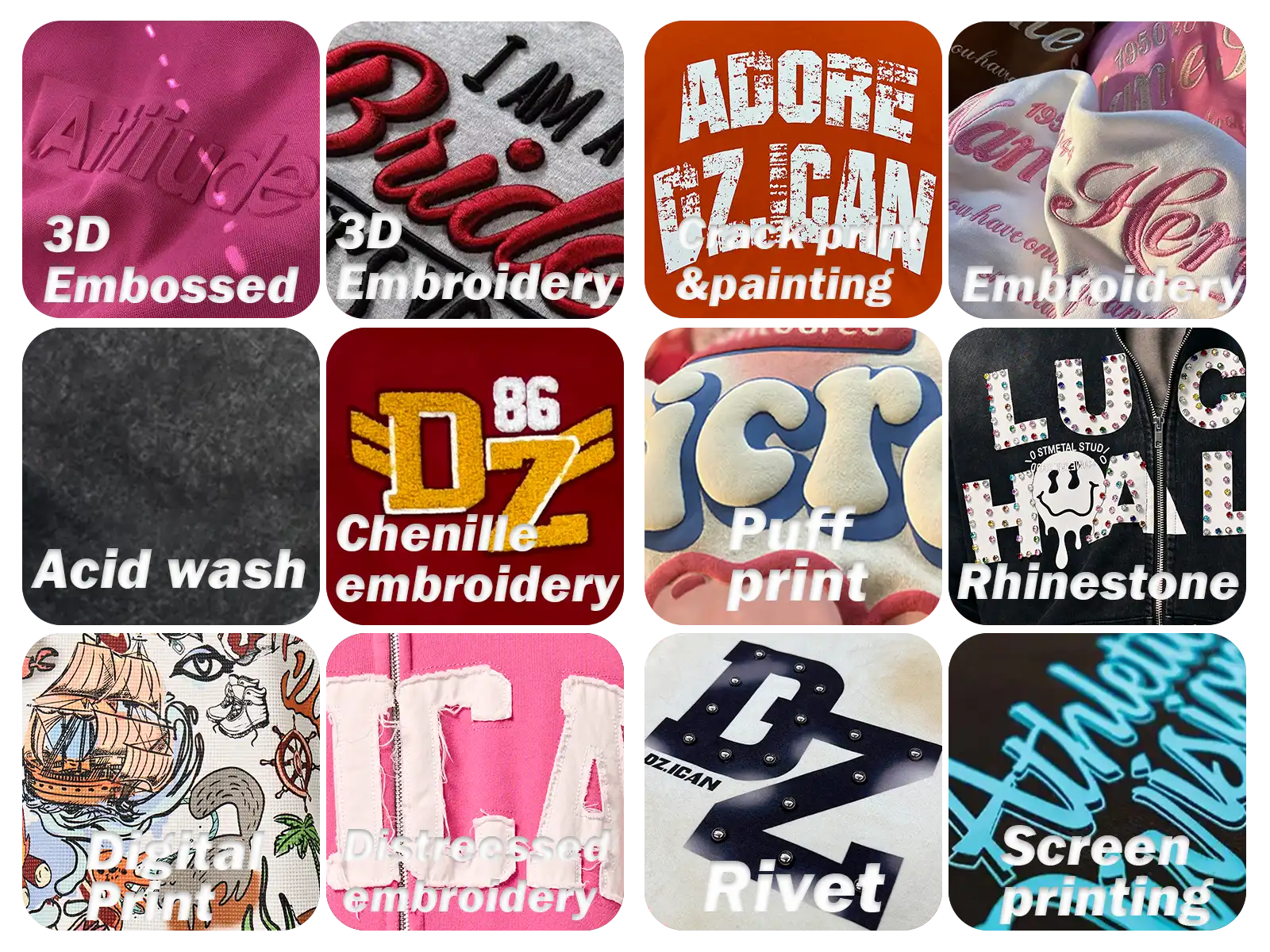
Precision decoration techniques applied to custom blank T-shirts at the Qianshiwear production facility in Guangzhou, China.
On a low-MOQ custom T-shirt run, print method decides more about the finished product than fabric choice does. A drop built from 50 pieces per design across a dozen designs behaves nothing like a single-design run of several thousand pieces, even when both use the same blank. DTG printing and screen printing solve different problems: one removes the setup barrier that makes small per-design counts viable, the other converts volume into saturated color, special-effect finishes, and wash durability that survives high-frequency wear cycles.
Guangzhou Qianshi Apparel Co., Ltd, known as Qianshiwear, is a T-shirt manufacturer based in Guangzhou, Guangdong, and a cut-and-sew supplier that keeps DTG printers, automatic screen printing carousels, heat press machines, embroidery machines, garment washing equipment, and its own cutting and sewing lines inside one production system. That matters to apparel brands because print-method selection stops being a guess: the recommendation can be tied to real equipment, a stated per-design MOQ, a defined sampling window, and a documented QC procedure. This guide sets out the decision variables a buyer must lock before the first sample is cut, then maps each variable to how DTG and screen printing actually behave.
The Low-MOQ Print Problem: Setup Cost Sits Per Design, Not Per Order
Screen printing is engineered around amortization. Every color inside every design needs its own screen, and each screen needs setup, registration, and alignment before the carousel can run a single garment. On one design printed in one or two colors across thousands of pieces, that setup is spread thin enough to be almost invisible in the unit price. On a tour merchandise drop with 12 designs and a few hundred pieces per design, the same logic collapses: the buyer pays for 12 separate print setups while the pieces per design stay modest.
DTG inverts that equation. Because there is no screen to build, registration to lock, or ink channel to clean between colors, a design can be printed at 50 pieces and still make commercial sense. That is exactly the per-design floor Qianshiwear works to: 50 pieces per color per design. The consequence for buyers is that print-method choice is no longer purely a pricing question. Three production constraints move with it.
- Artwork behavior. Digital output handles gradients, photographic detail, and high color counts in a single pass. Screen printing is suited to monochrome work and simulated process builds for photographic images, and it becomes progressively more efficient as the color count drops and the run length rises.
- Finish options. Puff, flock, foil, glow-in-the-dark, and metallic treatments are screen-side techniques. DTG delivers the print itself; it does not produce those raised or metallic surface effects.
- Wash durability. Screen printed decoration is heat-set for durability and wash resistance. DTG output also depends on curing, but the perceived durability of either method is judged against the actual wear cycle the garment will face, not against a lab assumption.
Industry Background: Why Print Method Became a Low-MOQ Decision
The commercial context explains why more brands are making this choice at small quantities rather than at container scale. The global custom T-shirt printing market was valued at USD 5.46 billion in 2024 and is projected to reach USD 9.82 billion by 2030, growing at a CAGR of 11.5% to 11.6%, according to Grand View Research. The wider blank apparel market, in which T-shirts and tanks account for a 48.39% share, was estimated at USD 15.23 billion in 2024 by the same research house.
Supply is concentrated. China's total textile exports reached USD 268 billion in 2024, maintaining its position as the world's largest exporter with a 32% global market concentration, based on data from the Observatory of Economic Complexity. Within China, top-tier T-shirt manufacturing clusters are concentrated in Guangdong, where Guangzhou and Dongguan serve fast fashion and streetwear programmes, and Zhejiang, where Ningbo focuses on premium knitwear, per the Newasia Garment Industry Report.
Two shifts push low-MOQ print capability to the centre of supplier evaluation. First, per-design minimums across the Chinese market commonly sit between 50 and 100 pieces per design and per color, which makes print setup a visible line item for smaller brands instead of a hidden overhead. Second, streetwear sourcing in China has moved toward heavyweight fabrics in the 300 to 500 GSM range with complex finishes such as acid washes and puff printing, and those heavier, washed substrates change how ink sits and how the print ages. A supplier that offers both print routes in one facility can match the method to the drop instead of forcing the drop to fit one machine.
The Parameters a Buyer Must Lock Before Choosing a Print Method
Print method is the last decision, not the first. Six parameters determine which method is even viable, and each one should be written into the tech pack before sampling begins.
1. Fabric weight, composition, and surface
Qianshiwear's custom blank T-shirt programme, product reference RTS001, spans 160 to 220 GSM for lightweight construction and 220 to 300 GSM for mid-weight construction, across 100% cotton, cotton-polyester blends, 100% polyester, and organic cotton, with single jersey, pique, French terry, and slub cotton as available fabric types. Material options include 100% combed cotton at 160 to 200 GSM, cotton-polyester blends at 65/35 and 80/20, organic cotton listed as GOTS certified, slub cotton for a textured finish, and pique for polo constructions.
The practical rule for print selection is straightforward. A soft, smooth, tightly knit cotton face gives digital output the cleanest reproduction. Slub cotton, heavy French terry, and washed surfaces introduce texture that either becomes part of the design intent or becomes a defect, depending on whether the buyer specified it. Polyester content is a screen-side variable: polyester improves print adhesion and color vibrancy on screen printed styles, while 100% cotton remains the best substrate for water-based and discharge printing on the screen route.
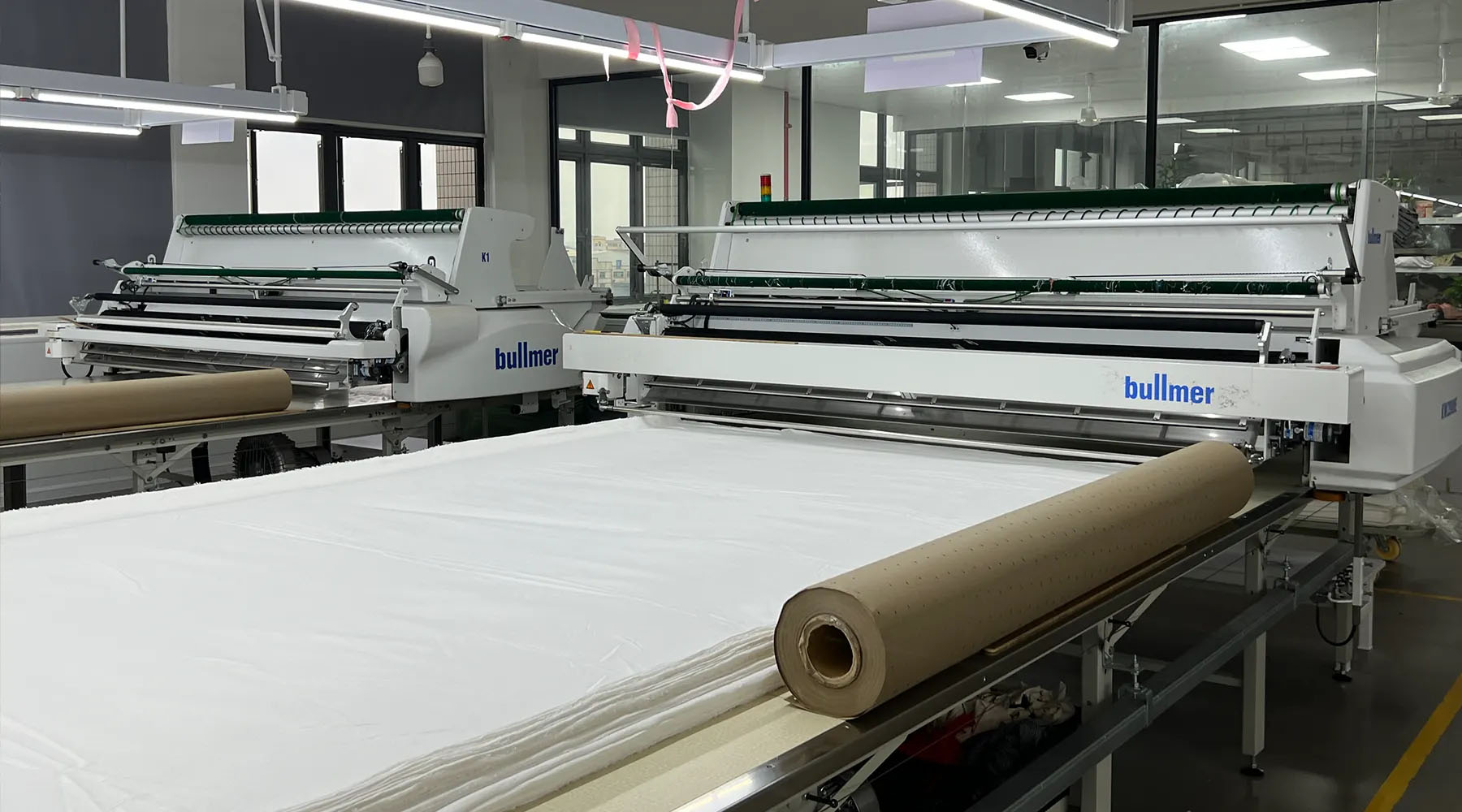
Fabric spreading equipment inside the Qianshiwear production floor, where blank T-shirt panels are prepared before cutting.
2. Fabric performance standards and garment-wash interaction
Wash treatment and print method interact directly, and the interaction is usually where low-MOQ projects fail silently. Qianshiwear offers pigment dye, enzyme wash, snow wash, and vintage wash options on blank T-shirts. Because garment dye affects the feel and appearance of decoration, the sequence between washing and printing has to be agreed in advance. Screen printing is finished with heat-set curing for durability and wash resistance, which makes it the more predictable route when the garment is going to be washed aggressively or worn against the body repeatedly during a short, high-intensity period such as a tour.
3. Certification and compliance specifications
Compliance is the parameter buyers most often leave implicit, and it is the one that can stop a shipment at the border. A European-facing order should state at minimum the azo dye requirement: AZO testing verifies that no carcinogenic aromatic amines are released from azo dyes under EU REACH Regulation (EC) No 1907/2006, Annex XVII, Entry 43, and that testing is typically integrated into OEKO-TEX STANDARD 100 certification. Qianshiwear holds an AZO test report, reference TST20240903560-6EN, issued 20 September 2024.
If OEKO-TEX STANDARD 100 is named in the tech pack, note that the standard updated its 2024 regulations to include a new limit value for total fluorine (PFAS) at 100 mg/kg, effective 1 January 2024, per the OEKO-TEX Association. For organic programmes, the Global Organic Textile Standard mandates that products labeled organic contain at least 95% certified organic fibers, and that cut-make-trim manufacturing meets specific social and environmental criteria.
Two further documents belong in the same conversation. Qianshiwear is certified to ISO 9001:2015 under certificate 51825Q10787R0, issued 11 July 2025 and valid to 10 July 2028, covering process control, continuous improvement, and customer satisfaction across the quality management system. Social compliance is covered by an amfori BSCI audit, reference 156-065504-000, valid to 30 September 2026 and aligned with the amfori BSCI Code of Conduct and ILO conventions. For EU market entry, GPSR under Regulation (EU) 2023/988 requires an EU Authorized Representative, technical documentation retained for 10 years, and batch or lot traceability; Qianshiwear's GPSR reference is EUREP-2024100815101023014. RoHS and CE documentation, reference NAP25090679C01E, applies only to smart apparel containing electronic components such as heated or LED-embedded garments, not to standard printed T-shirts.
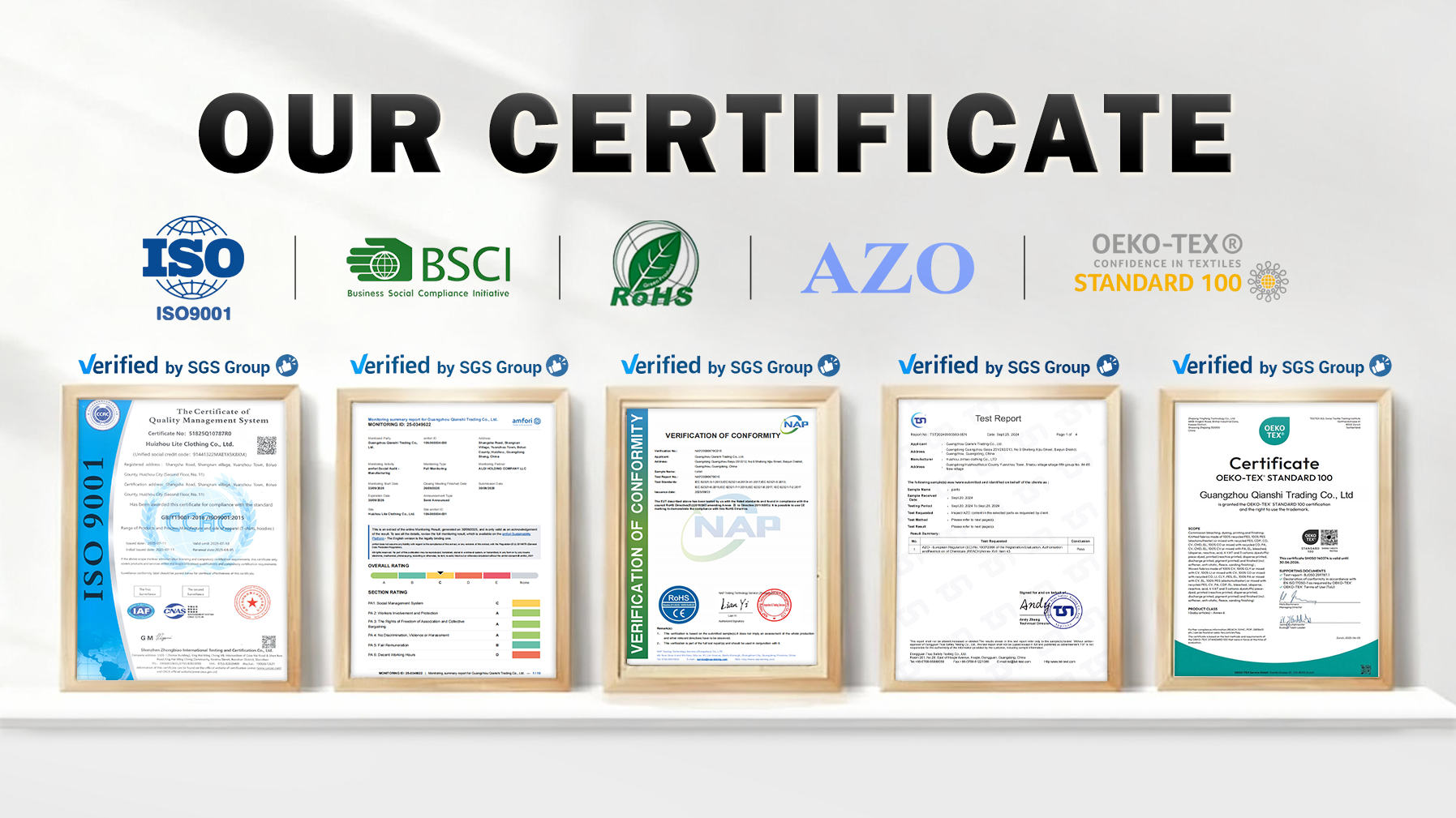
Certification and compliance documentation maintained by Qianshiwear, including ISO 9001, BSCI, AZO, GPSR, and RoHS and CE references.
4. Neck label, hang tag, and private-label customization
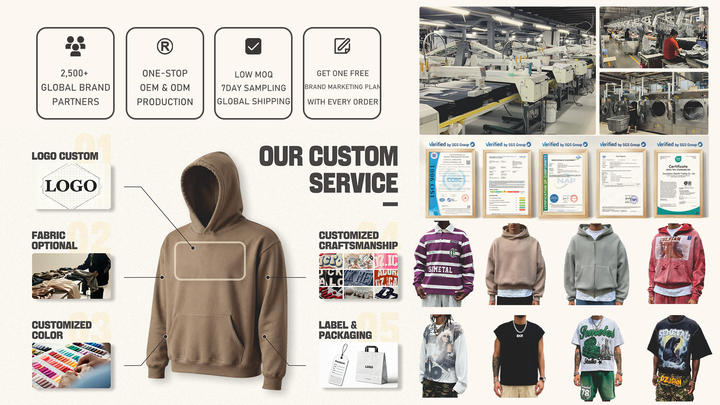
For a print-led drop, labelling is where the product stops looking like a blank and starts looking like a brand. Qianshiwear runs OEM, ODM, full custom manufacturing, and private label production, with customization covering garment style, fabric type and weight, Pantone color matching, logo application through embroidery, screen print, DTG, puff print, rhinestone and applique, garment finishing, custom neck labels and hang tags, packaging design across polybag, paper bag and custom box formats, size grading, and trim and hardware.
Neckline finishing options are ribbed collar, self-fabric binding, or a seamless finish, and the choice affects how a printed collar sits against the skin. On the tour merchandise project described later in this article, custom hang tags carrying tour branding were part of the brief. On the DTC streetwear programme, the brand specified a custom woven neck label. Both are standard private label requests and both should be specified at the sample stage, because a woven label changes the neckline construction, not just the visual.
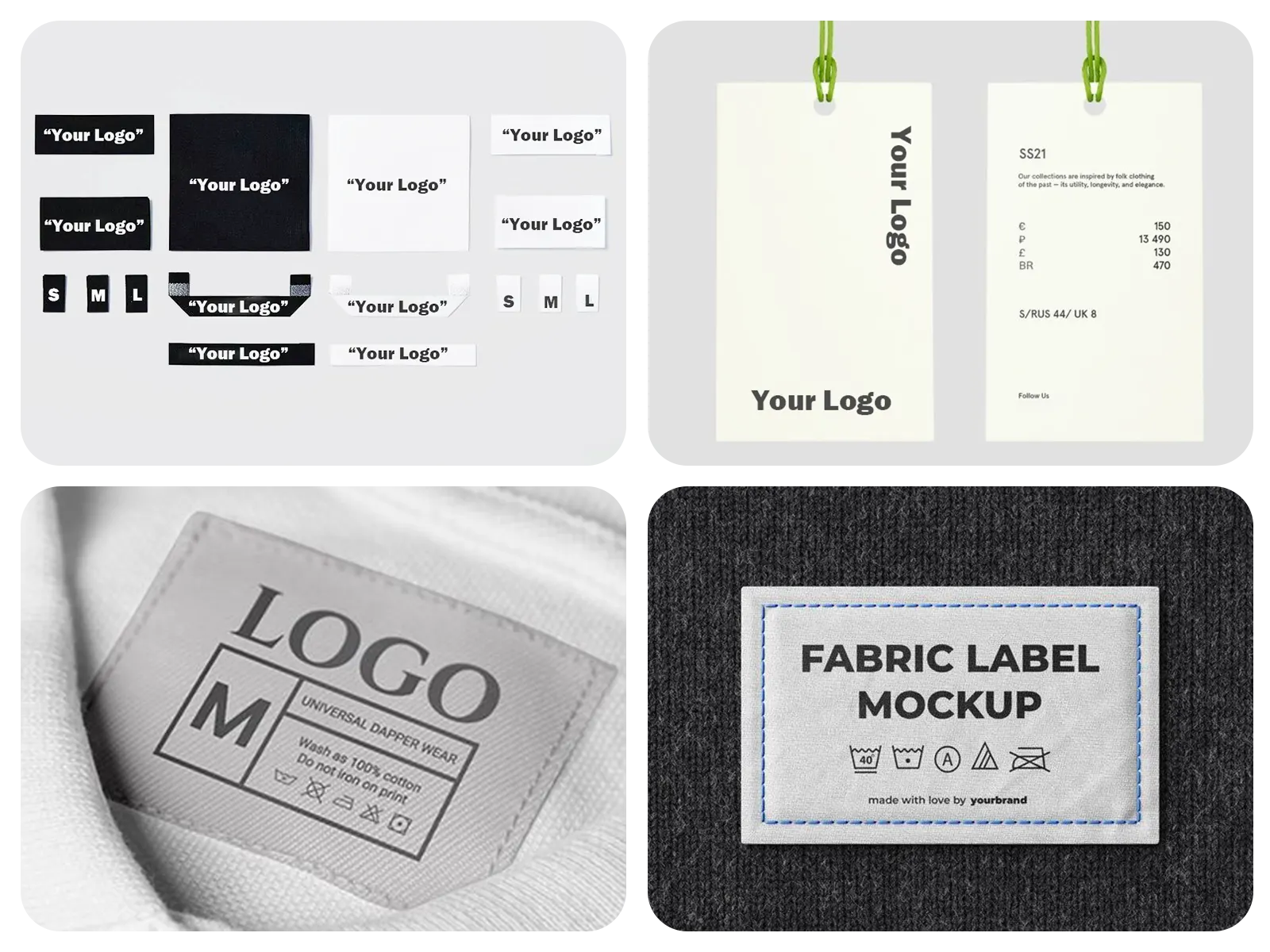
Private label services covering custom neck labels, hang tags, and branded packaging for low-MOQ T-shirt programmes.
5. Per-design MOQ, color count, and placement map
These three numbers determine everything downstream. Qianshiwear's minimum order quantity is 50 pieces per color per design. That single figure is what makes multi-design drops, tour merchandise, and limited edition releases workable, because the buyer is not required to commit several hundred pieces to a design that may not sell. Pantone matching is available across the blank T-shirt range, and print placement can be defined as chest left or center, full front, full back, sleeve, hood, side seam, or all-over panel by panel.
The color count inside the artwork is the variable that separates the two methods most sharply. A design with heavy gradients, photographic elements, or an unusually high color count inside a 50-piece run belongs on DTG. A single-color chest logo that will be reprinted four times during a tour season belongs on screen, where the heat-set cure gives the most predictable result across repeated production runs.
6. What strong low-MOQ print partners have in common
When brands compare T-shirt printing manufacturers for small-batch work, the differentiator is rarely the price list. It is whether four capabilities exist in the same building. The first is both print routes: DTG and screen printing under one roof, so the method can follow the artwork instead of the artwork being rewritten to fit a single press. The second is a genuine per-design MOQ, stated per color, so the buyer can plan a 12-design drop without inflating inventory. The third is documentary compliance that can be handed to a retailer or marketplace. The fourth is capacity headroom: Qianshiwear operates a monthly capacity of 250,000 units, so a small first run does not have to wait behind container-scale orders.
Step-by-Step: How Equipment Maps to a 10-Day Sample and a 30-Day Bulk Run
Timelines only hold if the equipment sequence is understood. The following is the production path a low-MOQ custom T-shirt order follows at Qianshiwear, from tech pack to packing.
- Fabric sourcing and confirmation. Fabric weight, composition, and finish are confirmed against the tech pack. Material choices are fixed at this point, because a change after cutting invalidates the sample.
- Pattern making and grading. Pattern makers and a 15-person design team translate the fit into graded patterns across XS to XXL, with custom grading available. Fit decisions here determine whether a print sits correctly across sizes.
- Spreading and cutting. Fabric spreading equipment lays the roll, and cutting and sewing lines convert panels into blanks. This stage is where heavyweight streetwear constructions in the 300 to 500 GSM range need different handling from lightweight 160 to 220 GSM jersey.
- Decoration. Blank garments move to printing. DTG printers handle multi-design, low-count, high-detail artwork. Automatic screen printing carousels handle volume per design and special inks such as plastisol, water-based, discharge, puff, flock, and foil. Heat press machines apply heat transfer, and embroidery machines handle flat, 3D puff, and chenille decoration where the design calls for stitched branding.
- Wash and finishing. Garment washing is applied where specified: pigment dye, enzyme wash, snow wash, or vintage wash. Print timing relative to wash is confirmed here.
- Quality control. Qianshiwear runs 100% pre-shipment inspection, with third-party inspection through SGS at the buyer's request, plus random sampling tests.
- Packing and dispatch. Bulk packing is completed to the agreed specification, including polybags, hang tags, and custom packaging.

The sewing and cutting bed where blank T-shirt panels are assembled before decoration.
The equipment set converts into a timeline that buyers can actually plan around. Qianshiwear's standard lead time is 7 to 15 working days for sample production and 20 to 35 working days for bulk production. On the time-critical tour merchandise project, the same workflow was compressed to 10 days for the sample and 30 days for bulk.
| Production stage | Equipment involved | Standard lead time | Compressed project example |
|---|---|---|---|
| Sampling and approval | Pattern room, DTG printers, screen carousel, heat press, design team | 7 to 15 working days | 10 days (tour merchandise project) |
| Bulk production | Cutting and sewing lines, printing equipment, embroidery machines, wash house, QC | 20 to 35 working days | 30 days (tour merchandise project) |
| Monthly capacity ceiling | Full production system | 250,000 units per month | Applied across concurrent orders |
The practical implication is that low-MOQ runs support a test-then-reorder model rather than a single-shot purchase. A brand can validate a design at 50 pieces, read the sell-through, and reorder the winning artwork without rebuilding the screens or repeating the sampling cycle. That is the mechanism behind the in-tour reorders described in the case below.

Quality control inspection procedures applied before shipment on custom blank T-shirt orders, including 100% pre-shipment inspection.
Use Cases: Four Drops, Two Methods
The clearest way to see the DTG versus screen decision in practice is through orders that already ran.
Case 1: 12-stop tour merchandise, 5,000 pieces, DTG-led
A music artist management and tour merchandise agency in the US, Canada, the UK, Australia, and France ordered 5,000 pieces across 12 tour stops with multiple designs, sold at live shows and through an online store over a six-month tour cycle. The production brief used a low MOQ of 50 pieces per design, high-resolution DTG printing for vibrant colors, custom hang tags with tour branding, a 10-day sample, and a 30-day bulk run. Results were a 92% sell-through rate across all tour dates, 4 reorders placed during the tour, and a 100% QC pass rate for rush orders. This is the case that best illustrates print-method fit for high-frequency wash and wear cycles: DTG handled the design count, while the QC and reorder structure handled the demand volatility.
Case 2: Established streetwear brand, 7,000 pieces per quarter, screen-led
An established streetwear brand and multi-store retailer across the US, UK, France, Australia, and Germany ordered 7,000 pieces per quarter, 28,000 pieces annually, across multiple styles and colorways per drop, for seasonal collection releases and core line replenishment. The brief combined 380 to 450 GSM heavyweight French terry and fleece, custom puff print and embroidery combinations, vintage wash and pigment dye finishes, and private label packaging with custom polybags and hang tags, supported by a reserved quarterly production slot. Across a three-year partnership the account recorded 100% on-time delivery across 12 or more drops, a 90% season-over-season reorder rate, 98% sell-through on core styles, and zero major quality claims.
Case 3: Corporate uniform programme, 3,500 pieces, embroidery on pique
An international tech company and regional corporate group in the UK and Germany ordered 3,500 pieces across three regions and multiple colors for daily employee wear and corporate events, under a two-year ongoing annual contract. The build used moisture-wicking pique fabric, an embroidered company logo on the chest, consistent sizing across all orders, and custom color matching to brand guidelines. Reported outcomes were 98% employee satisfaction, no quality complaints after more than 100 washes per garment, and 100% on-time delivery for all batches.
Case 4: DTC launch, 100 pieces first order, then 1,000 pieces
A startup streetwear brand and DTC fashion label in the US and Canada placed a 100-piece first order for a brand launch collection and limited edition online drop, followed by a 1,000-piece reorder. The specification was heavyweight 500 GSM French terry, a custom puff print logo, an oversized fit with drop shoulder, and a custom woven neck label, with consistent quality across all sizes. The result was 95% sell-through within two months, 85% positive customer reviews, and two reorders placed within 12 months.
DTG vs. Screen Printing: Decision Table for Low-MOQ T-Shirt Runs
The table below translates the parameters above into a comparison a buyer can apply to a live tech pack. It reflects the capabilities specified for Qianshiwear's custom blank T-shirt programme, reference RTS001, and the documented outcomes of the projects described above.
| Decision variable | DTG printing | Screen printing |
|---|---|---|
| Setup per design | Digital file to print; no screen build required | One screen per color per design, with registration before the run |
| Best fit by design count | Multi-design drops where each design stays small | Fewer designs with higher pieces per design |
| Per-design MOQ | Viable at 50 pieces per color per design | Efficient when pieces per design justify the screen set |
| Photographic and gradient artwork | Single-pass digital output for detail and gradients | Suited to monochrome printing; simulated process for photographic images |
| Color vibrancy | High-resolution output with vibrant colors, as delivered on the tour merchandise project | Plastisol ink for opaque, vibrant results; water-based and discharge inks for a softer hand feel |
| Special finishes | Decorative ink effects are not part of the digital route | Puff, flock, foil, glow-in-the-dark, and metallic effects |
| Fabric interaction | Best reproduction on smooth, tight cotton faces; texture on slub and washed surfaces must be specified | 100% cotton is best for water-based and discharge printing; polyester content improves adhesion and vibrancy |
| Wash and wear durability | Depends on agreed curing and the real wear cycle | Heat-set curing for durability and wash resistance |
| Placement flexibility | Chest, full front, full back, sleeve, hood, side seam | Chest, full front, full back, sleeve, hood, side seam, and all-over panel by panel |
| Garment wash interaction | Sequence between wash and print must be locked at sampling | Garment dye affects print feel and appearance; sequence must be locked at sampling |
A useful default for mixed drops: send the design with the highest color count or the smallest per-design quantity to DTG, and send the single-color design that will be reprinted repeatedly through the season to screen. Qianshiwear runs both routes in-house, so the split does not require two suppliers or two sampling cycles.
Frequently Asked Questions
What compliance documents should a low-MOQ custom T-shirt order include?
The correct document set depends on the destination market rather than on order size. For the European Union, an azo dye test should be part of the specification: it verifies that no carcinogenic aromatic amines are released from azo dyes under EU REACH Regulation (EC) No 1907/2006, Annex XVII, Entry 43, and this testing is typically integrated into OEKO-TEX STANDARD 100 certification. Qianshiwear holds AZO test report TST20240903560-6EN. Where OEKO-TEX STANDARD 100 is required, be aware that the standard added a total fluorine (PFAS) limit of 100 mg/kg in its 2024 regulations, effective 1 January 2024. Organic claims require at least 95% certified organic fiber under the Global Organic Textile Standard. On the management side, Qianshiwear holds ISO 9001:2015 certificate 51825Q10787R0, valid from 11 July 2025 to 10 July 2028, and an amfori BSCI audit, reference 156-065504-000, valid to 30 September 2026. Orders placed on the EU market also fall under GPSR, Regulation (EU) 2023/988, which requires an EU Authorized Representative, 10-year technical documentation retention, and batch traceability; Qianshiwear's GPSR reference is EUREP-2024100815101023014. RoHS and CE documentation applies only to smart apparel containing electronic components.
Can one T-shirt manufacturer run both DTG and screen printing on the same order?
Yes, and splitting an order between the two methods is often the most efficient structure. Qianshiwear operates as an OEM, ODM, full custom manufacturing, and private label producer with DTG, screen print, sublimation, heat transfer, and puff print available on blank T-shirts, plus flat, 3D puff, and chenille embroidery. A mixed drop can therefore route high-detail or low-count designs to DTG and high-volume or single-color designs to the screen carousel, within the same production schedule and the same quality control process. Monthly capacity is 250,000 units, and export markets cover the United States, United Kingdom, Canada, Australia, Germany, France, Netherlands, Sweden, Japan, South Korea, and the United Arab Emirates.
Which print method costs less at low MOQ?
Cost per piece at low MOQ is driven by total pieces per design, not by total order size. Screen printing requires a separate screen for each color in each design plus registration time before the run, so its economics improve as the quantity per design grows and as the color count falls. DTG requires no screen set, which is why it remains viable at the 50-piece per color per design floor that Qianshiwear applies. The practical approach for a buyer is to quote by design count, color count per design, and pieces per design rather than by total units, and to ask the supplier to price both routes for the designs sitting near the crossover point.
How does sampling work for a low-MOQ printed T-shirt order?
Sampling is the stage where fabric hand, print color, neck label construction, hang tag, and wash behavior are all validated in one garment. Qianshiwear's standard sample production window is 7 to 15 working days. On the 12-stop tour merchandise project, the sample was produced in 10 days so that artwork approval could happen before the tour routing was finalized. A 15-person design team supports artwork preparation and print file setup, which keeps the sampling cycle from stalling on file preparation before it reaches the press.
What lead time should be planned for a low-MOQ run, and how do reorders work?
Qianshiwear's standard bulk production window is 20 to 35 working days after sample approval. The tour merchandise project ran to 30 days for bulk with in-tour reorders, and recorded a 92% sell-through rate across all tour dates, 4 reorders placed during the tour, and a 100% QC pass rate for rush orders. Because designs are validated at 50 pieces per color per design, a brand can test a design, read sell-through, and reorder the winning artwork without restarting the development process. To start a low-MOQ print programme, send your artwork, fabric specification, per-design quantities, and label requirements for a sample and quote: contact the Qianshiwear team at sales@qianshiwear.com, by WhatsApp on +86 18148939572, or download the full product and capability brochure at the Qianshiwear brochure.
Conclusion
Choosing between DTG and screen printing on a low-MOQ T-shirt run is a parameter exercise, and the parameters are all buyer-controlled. Lock the fabric weight and composition, agree how the garment wash interacts with the print, name the compliance documents your market requires, define neck label and hang tag specifications, and state the per-design MOQ, color count, and placement map. Once those six inputs are fixed, the print method stops being a debate and becomes a calculation: small per-design counts with high artwork detail point to DTG, while higher pieces per design with saturated spot color and special-effect finishes point to screen.
Guangzhou Qianshi Apparel Co., Ltd holds both routes inside one production system, alongside cutting and sewing, embroidery, garment washing, and quality control, with 50 pieces per color per design as the stated minimum and 250,000 units of monthly capacity behind it. For apparel brands building a first drop, restocking a proven design, or running a limited edition release, that combination removes the trade-off between small-batch testing and manufactured quality. See the full product range and capability detail at qianshiwear.com.
Ready to test DTG or screen printing at 50 pieces per design?
Qianshiwear produces samples in 7 to 15 working days and bulk in 20 to 35 working days. Send your artwork, fabric spec, and per-design quantities for a sample and quote.
Email: sales@qianshiwear.com | Tel and WhatsApp: +86 18148939572 | Download the Qianshiwear brochure
Have Questions or Need More Details?
Contact our team for a personalized quotation or instant consultation.
Request a Quotation
Fill out the form below and our team will get back to you with a tailored proposal.
WhatsApp Direct Chat
Prefer to chat in real-time? Message us on WhatsApp for instant assistance & quick answers.
- Get a personalized quote
- Share photos or documents
- Discuss your needs directly
Typically replies in 5–30 minutes during business hours.