Custom Screen Print vs. Embroidery Hoodies: Which Decoration Method Suits Your Streetwear Drop?
Custom Screen Print vs. Embroidery Hoodies: Which Decoration Method Suits Your Streetwear Drop?
Why Screen Print vs. Embroidery Is a Real Sourcing Decision
For a streetwear launch, the decoration method is not an afterthought. Screen printing and embroidery change the look, hand feel, placement, and durability of the finished hoodie. They also influence which hoodie manufacturer you need, how your artwork is prepared, and what kind of sample testing can be done before bulk production.
This guide is written for emerging streetwear brands that are moving from concept to a first or second drop. It compares two Qianshiwear product routes: RTS005 Custom Screen Print Hoodie / Custom Screen Print Sweatshirt and RTS004 Custom Embroidery Hoodie. The goal is not to declare a single winner. Instead, it treats the choice as part of a wider decision about design complexity, intended aesthetic, fabric weight, and how much washing the garment will face.
Qianshiwear, officially Guangzhou Qianshi Apparel Co., Ltd, is a Guangzhou-based apparel manufacturer and trading company offering OEM, ODM, and full custom production. The Qianshiwear catalogue includes hoodies, sweatshirts, sweatpants, tracksuits, polos, and other garments, with 85–90% of production exported to international markets such as the EU, USA, Australia, and UK.
The Problem: Streetwear Names Need Both Visual Impact and Long-Term Wear
Streetwear buyers often respond first to a graphic or a texture. A puff print logo on a heavyweight body can feel current. An embroidered chest logo or appliqué patch can communicate a more permanent, almost club-like identity. Both routes can work for a launch collection, but they solve different design problems.
During evaluation, brands frequently ask: should the hero piece use a raised print or a stitched logo? The answer depends on several factors:
- Design complexity: Is the artwork a large graphic with multiple colors or a compact emblem that can be reproduced in thread?
- Intended aesthetic: Does the drop need a tactile puff-print look, or an embroidered and patch-focused identity?
- Fabric interaction: Heavyweight French terry and brushed fleece create different bases for print and embroidery.
- Wash behavior: Streetwear hoodies are washed often. Decoration must survive not just the first Instagram post but repeated laundry cycles.
These questions are often more important than asking which method is cheaper or faster in the abstract. There is no universal price comparison in this article; instead, the useful comparison is which decoration route is most credible for your specific hoodie.
Industry Background: Decoration Is Growing Inside a Large Hoodie Market
The hoodie market context helps explain why decoration choices matter. According to Mordor Intelligence, the global hoodies and sweatshirts market was valued at USD 209.26 billion in 2025 and is projected to reach USD 303.62 billion by 2031. Industry data from Dataintelo also shows that pullover hoodies accounted for 38.4% of product type share in 2025, partly driven by streetwear and athleisure trends.
Within custom apparel, Grand View Research reports that the custom hoodie printing market is growing at a CAGR of 9.9% from 2024 to 2030, with strong demand for 3D puff embroidery and eco-friendly water-based inks. This is useful context because both decoration types are relevant to modern streetwear, not just legacy logo work.
There is also a fabric-level trend. Industry sources point to heavyweight hoodies of 350–450+ GSM using 100% cotton French Terry as the preferred base for premium streetwear because of structure and pilling resistance. In production terms, this means the blank garment and the decoration method should be planned together.
Detailed Solution: Screen Print and Embroidery as Separate Product Routes
Route 1: Custom Screen Print Hoodie / Sweatshirt — RTS005
Qianshiwear separates screen print hoodies into the RTS005 product line. This route is designed for graphic-led hoodies and sweatshirts, with printed effects applied to pulled hoodies, zip-ups, oversized silhouettes, and cropped shapes where applicable.
According to the verified product sheet, RTS005 supports fabric weights of 280–350 GSM for mid-weight garments and 350–450 GSM for heavyweight garments. Brushed fleece is listed at 350–420 GSM for winter hoodies with bold prints, while French Terry at 280–350 GSM is positioned for transitional seasons. The garment can use 100% cotton, cotton-polyester blends such as 80/20 or 70/30, French terry, or brushed fleece.
Screen print types available on RTS005 include:
- Plastisol ink
- Water-based ink
- Discharge ink
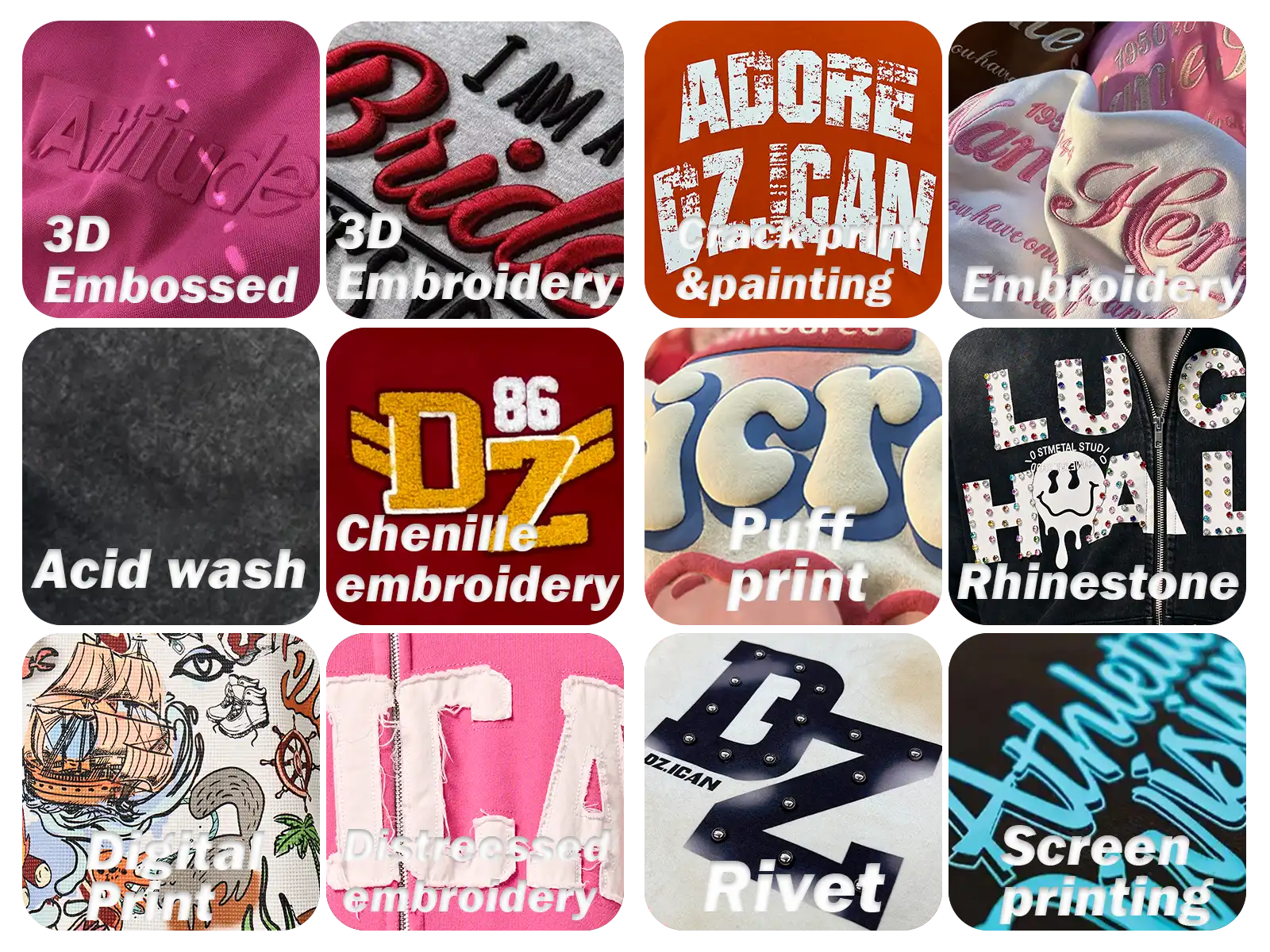
- Puff print
- Flock print
- Foil print
- Glow-in-the-dark ink
- Metallic ink
Print placement is also part of the decision. The product line supports chest printing, full front, full back, sleeve, hood, side seam, and all-over panel-by-panel screen print. The spec sheet notes that screen print works for monochrome designs and simulated process for photographic images. Heat-set curing is listed as the method for durability and wash resistance.
For a streetwear drop, the most relevant effect is puff print. Puff print is a raised screen-printed texture. In one verified Qianshiwear project for a US/CA emerging streetwear brand, the launch used heavyweight 500 GSM French terry with a custom puff print logo, an oversized fit with drop shoulder, a custom woven neck label, and consistent quality across all sizes. This case comes from the RTS005-related product route and shows puff print being used as the hero decoration.
Route 2: Custom Embroidery Hoodie — RTS004
Embroidery is a separate production route because it changes stitching requirements, backing, stabilizers, and placement planning. Qianshiwear lists this as RTS004 Custom Embroidery Hoodie, covering appliqué, patchwork, chenille patch, chest patch, sleeve patch, back patch, and letterman-style garments.
RTS004 is available in mid-weight 280–350 GSM, heavyweight 350–450 GSM, and ultra-heavyweight 450–500+ GSM fabric options. Materials include brushed fleece, French Terry, heavy cotton fleece, and cotton-polyester blends. Qianshiwear product data specifically lists brushed fleece at 380–500 GSM for winter hoodies with appliqué patches, and French Terry at 320–500 GSM for transitional use.
The decoration vocabulary for RTS004 is broader than simple chest embroidery:
- Flat embroidery
- 3D puff embroidery
- Chenille embroidery
- Appliqué embroidery
- Satin stitch outlines
- Chain stitch details
- Woven patch or leather patch options
Placement options include left or center chest, shoulder or forearm sleeves, back large patches, hood small logos, and pocket corner details. The material data also explains why embroidery is often paired with special fabrics: Chenille yarn gives a fuzzy varsity texture, twill fabric creates a durable woven patch, and leather adds a high-end appliqué option.
Embroidery is not necessarily an alternative to puff print. It is better understood as a different design language. In the same way that puff print can create a raised graphic, 3D puff embroidery can create dimensional lettering, while appliqué patches add a separate constructed layer to the garment.
Can You Combine Screen Print and Embroidery?
Yes. Qianshiwear’s customization capability includes garment style, fabric type, color, and multiple logo application options such as embroidery, screen print, DTG, puff print, rhinestone, and appliqué. Brands do not need to choose one decoration type for every product within a drop.
A verified case for an established streetwear brand using Qianshiwear’s production over three years involved heavyweight 380–450 GSM French terry and fleece pieces with custom puff print and embroidery combinations. That customer ordered 7,000 pieces per quarter, or about 28,000 pieces per year, and maintained 100% on-time delivery across more than 12 drops. The same range also included vintage wash, pigment dye, private label packaging, and quarterly production slots.
The practical implication: screen print and embroidery can coexist on different SKUs, or even on the same garment when the design plan justifies it.
Step-by-Step: How to Choose the Decoration Route for a Hoodie Drop
Evaluation-stage buyers need a repeatable decision process. The following steps are based on Qianshiwear product parameters and verified case evidence. Use them as a starting point for your own sample plan.
Step 1: Classify the artwork
Start with the artwork, not with a favorite decoration method. If the design is a graphic-led piece with large printed shapes, multiple print placements, or special ink effects such as puff, foil, or flock, the RTS005 screen print route is the more direct path. If the design is a logo, emblem, crest, monogram, or patch that needs the depth of stitched texture, the RTS004 embroidered route is more appropriate.
When in doubt, ask whether the artwork can be separated into thread-friendly shapes. Small text, fine gradients, and high-detail photographic graphics are generally harder to translate into embroidery. Screen print has a broader range of ink systems for graphic-heavy work.
Step 2: Choose the fabric with the decoration in mind
Fabric selection should support the decoration method. A garment intended for screen printing should have a surface and weight that can handle the print layering. In the verified US/CA start-up case, 500 GSM French terry was used with a custom puff print logo on an oversized drop-shoulder hoodie. This combination is a good production example of matching a heavy streetwear silhouette with a raised print.
For embroidered hoodies, Qianshiwear lists brushed fleece at 380–500 GSM and French Terry at 320–500 GSM as relevant materials. Heavier fabrics give embroidered patches a stable base and reduce the chance of the fabric puckering around dense stitch patterns.
Step 3: Define placement and physical coverage
Decoration placement changes the perceived design. Screen print can be used on the chest, full front, full back, sleeve, hood, side seam, or as all-over panel-by-panel artwork. Embroidery and appliqué can appear on the chest, sleeves, back, hood, or pocket corners.
If your design runs across seams or needs to cover a full hoodie body, screen print is the route with a panel-by-panel option. If the decoration is a compact badge near the chest or sleeve, embroidery and patch placement may be enough.
Step 4: Check production parameters and lead time
From a production standpoint, Qianshiwear’s stated MOQ is 50 pieces per color per design. Sample production takes 7–15 working days, and bulk production takes 20–35 working days. Factory capacity is about 250,000 pieces per month, with a team of 200–250 production line workers and additional quality control staff.
This matters because launch timing is often the real constraint. If your first streetwear order is small, low MOQ capability helps you test shelf response. If the drop is expected to scale quickly, the factory’s monthly capacity and reorder coordination should be included in your evaluation.
Step 5: Validate with samples and wash tests
For frequently washed hoodies, decoration durability cannot be assumed from a single mockup. Qianshiwear’s screen print product sheet lists heat-set curing specifically for durability and wash resistance. Embroidery durability should also be checked on your chosen fabric because stitch density, backing, and garment weight all affect how the embroidery survives laundering.
Verified evidence from an EU corporate uniform program shows that embroidered chest logos performed without quality complaints after 100+ washes per garment. For screen-printed puff pieces, no equivalent wash count is disclosed in the supplied case data, so a wash test is the responsible way to confirm performance.
Use Cases: Evidence from Real Streetwear and Corporate Programs
Use Case 1: Emerging Streetwear / DTC Launch in the US and Canada
One verified Qianshiwear project involved a startups emerging streetwear brand and DTC fashion label launching in the US/CA market. The brand began with 100 pieces as a first order, then placed a reorder of 1,000 pieces. The launch used heavyweight 500 GSM French terry, a custom puff print logo, oversized drop-shoulder silhouette, custom woven neck label, and consistent quality across sizes.
Results included a 95% sell-through rate within two months, 85% customer positive reviews, and two reorders within twelve months. For a young streetwear label, this suggests that puff-print decoration on a high-GSM French terry hoodie can be a commercially strong hero product, while custom woven neck labels provide a finishing detail that matters to repeat buyers.
Use Case 2: Established Streetwear Brand with Quarterly Drops
A second verified case involved an established streetwear brand and multi-store retailer with production in the US, GB, FR, AU, and DE. The brand ordered 7,000 pieces per quarter, or 28,000 pieces annually, across multiple styles and colorways. The production used heavyweight 380–450 GSM French terry and fleece, custom puff print and embroidery combinations, vintage wash and pigment dye finishes, and private label packaging.
Over three years, Qianshiwear delivered 100% on-time delivery across more than 12 drops, a 90% reorder rate season-over-season, a 98% sell-through rate on core styles, and zero major quality claims. This case is useful because it shows screen print and embroidery can be used together in a sustained streetwear program without causing production or delivery instability.
Use Case 3: EU Corporate Uniforms with Embroidered Logos
The third relevant case is an EU corporate program with 3,500 pieces across three regions. The product used moisture-wicking pique fabric, an embroidered company logo on the chest, consistent sizing across all orders, and custom color matching to brand guidelines. The project achieved 98% employee satisfaction, no quality complaints after 100+ washes per garment, and 100% on-time delivery for all batches.
This is not a streetwear case, but it is strong evidence for embroidered logo durability. If an embroidered chest logo can remain intact after more than 100 washes in a corporate program, the embroidery route deserves serious consideration for smaller logo placements on heavyweight hoodies.
Comparison Table: Custom Screen Print Hoodie vs. Custom Embroidery Hoodie
| Decision Factor | Custom Screen Print Hoodie | Custom Embroidery Hoodie |
|---|---|---|
| Product route | RTS005 Custom Screen Print Hoodie / Custom Screen Print Sweatshirt | RTS004 Custom Embroidery Hoodie |
| Main decoration options | Plastisol, water-based, discharge, puff, flock, foil, glow-in-the-dark, metallic | Flat embroidery, 3D puff embroidery, chenille, appliqué, woven patch, leather patch |
| Typical fabric positions | Brushed fleece 350–420 GSM; French Terry 280–350 GSM; heavyweight options up to 450 GSM | Brushed fleece 380–500 GSM; French Terry 320–500 GSM; ultra-heavyweight up to 500+ GSM |
| Placement options | Chest, full front, full back, sleeve, hood, side seam, all-over panel-by-panel | Chest, sleeve shoulder or forearm, back patch, hood, pocket corner |
| Observed commercial evidence | US/CA startup used 500 GSM French terry with puff print logo; 95% sell-through in 2 months | EU corporate embroidered logo; no quality complaints after 100+ washes per garment |
| Best aligned design situations | Graphic-led hoodies, large prints, all-over work, puff/foil/flock effects | Logo stitched identities, patches, crests, varsity and letterman styles |
Use the table as a comparison of verified capabilities, not as a fixed rule. The final selection should be based on your artwork, target customer, and wash-test results.
Frequently Asked Questions
How do I choose between custom screen print and custom embroidery hoodies?
Base the choice on your artwork and wear context. Qianshiwear separates these into two product routes: RTS005 for screen print, including special effects such as puff print, and RTS004 for embroidery, appliqué, and patches. If the priority is a raised graphic or large print on a heavyweight streetwear silhouette, screen-printed puff print is often the more direct route. If the priority is a stitched logo, crest, or patch, embroidery is the more direct route. In longer-running programs, both methods can coexist.
What is the difference between puff print and embroidered logos on hoodies?
Puff print is a raised screen-print effect listed under RTS005. Embroidery is a stitched decorative effect listed under RTS004, and it can include 3D puff embroidery, flat embroidery, chenille, appliqué, or woven patches. In one verified Qianshiwear launch, a puff print logo on 500 GSM French terry helped drive a 95% sell-through rate within two months. In another verified EU program, embroidered chest logos produced no quality complaints after 100+ washes per garment.
Can I combine screen printing and embroidery on the same hoodie program?
Yes. Qianshiwear supports multiple logo application methods, including embroidery, screen print, DTG, puff print, rhinestone, and appliqué. An established streetwear case used custom puff print and embroidery combinations on heavyweight 380–450 GSM French terry and fleece pieces with 100% on-time delivery across more than 12 drops. Combining methods is usually a design decision, not a factory limitation.
What MOQ and lead times should I expect for a custom hoodie decoration project?
Qianshiwear states an MOQ of 50 pieces per color per design. Sample production is 7–15 working days and bulk production is 20–35 working days. The factory capacity is about 250,000 pieces per month. These numbers allow a first-time brand to test a design in small quantity while still planning for larger reorders if the drop performs well.
How should I start a custom streetwear hoodie project with a manufacturer?
Start with a clear tech pack or design reference, including fabric weight, silhouette, decoration type, placement, and target size range. Then request a sample from the manufacturer to validate decoration quality and wash performance. Qianshiwear’s custom services include OEM, ODM, private label production, custom neck labels, hang tags, packaging, and fabric choice. Contact the Qianshiwear Team at sales@qianshiwear.com or WhatsApp +86 18148939572 for a production timeline.
Conclusion
Custom screen print and embroidery hoodies do not serve identical purposes. Screen print is the more flexible route for bold graphics, multi-placement artwork, and tactile effects such as puff, flock, and foil. Embroidery is the more expressive route for stitched branding, patches, 3D puff embroidery, and varsity-inspired design.
The evidence in this guide shows that both routes can succeed in streetwear if matched with the right fabric and production plan. A US/CA launch achieved strong sell-through with puff print on 500 GSM French terry. An EU corporate program proved embroidered logos can handle more than 100 wash cycles. A mature streetwear brand combined both methods in a quarterly program with high sell-through and no major quality claims.
For an emerging streetwear drop, the most reliable next step is not to pick a method solely from photos. Select your artwork and fabric, request samples, and run a wash test. Once the decoration survives real wear, you will have a stronger foundation for the full production run.
Get a practical sample before committing to a large hoodie order. Qianshiwear can develop a custom screen print hoodie, custom embroidery hoodie, or a mixed decoration strategy for your streetwear drop.
Contact Qianshiwear Team: sales@qianshiwear.com / WhatsApp +86 18148939572
Have Questions or Need More Details?
Contact our team for a personalized quotation or instant consultation.
Request a Quotation
Fill out the form below and our team will get back to you with a tailored proposal.
WhatsApp Direct Chat
Prefer to chat in real-time? Message us on WhatsApp for instant assistance & quick answers.
- Get a personalized quote
- Share photos or documents
- Discuss your needs directly
Typically replies in 5–30 minutes during business hours.