Custom Screen Print Hoodie vs. Custom Embroidery Hoodie: A 2026 Procurement Guide for Industrial Buyers Comparing Chinese OEMs and International Suppliers
For B2B buyers sourcing custom hoodies, choosing between screen printing and embroidery as the primary decoration method directly affects product performance, cost structure, and supplier selection. This guide provides a structured comparison of the two techniques, evaluates Chinese OEM versus international supplier trade-offs, and offers a three-step decision framework.
1. Product Comparison: Screen Print Hoodie vs. Embroidery Hoodie
The following comparison uses the Custom Screen Print Hoodie (Model RTS005) and the Custom Embroidery Hoodie (Model RTS004) as reference products. Both are available from Guangzhou Qianshi Trading Co., LTD (brand: Qianshiwear), a Chinese OEM/ODM manufacturer founded in 2014.
| Dimension | Screen Print Hoodie | Embroidery Hoodie |
|---|---|---|
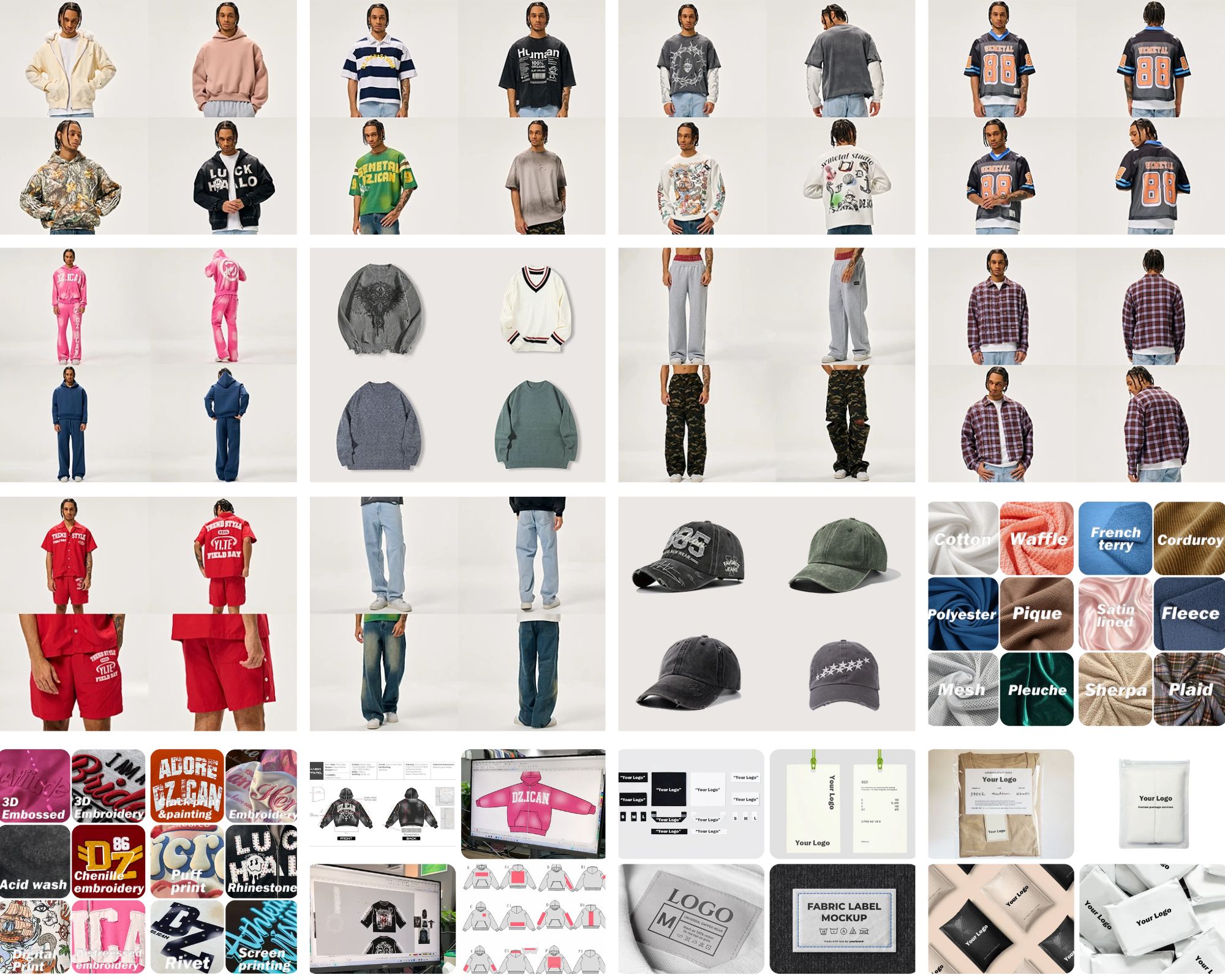
| Technical Parameters | Fabric weight: 280–350 GSM (mid-weight) or 350–450 GSM (heavyweight). Fabric composition: 100% Cotton / Cotton-Polyester Blend / Brushed Fleece / French Terry. Screen print ink types available: Plastisol, Water-based, Discharge, Puff, Flock, Foil, Glow-in-the-dark, and Metallic inks. Print placement includes chest, full front/back, sleeve, hood, side seam, and all-over (panel by panel). |
Fabric weight: 280–350 GSM (mid-weight), 350–450 GSM (heavyweight), or 450–500+ GSM (ultra-heavyweight). Fabric composition: similar to screen print options. Appliqué types include flat, 3D puff, chenille, woven patch, and leather patch. Embroidery types include flat, 3D puff, satin stitch, and chain stitch. Placement covers chest, sleeve, back, hood, and pocket. |
| Applicable Scenarios | Best suited for large, multi-color graphic designs, photographic images, and bold brand logos. Commonly used in streetwear, music merchandise, event apparel, and e-commerce brands where vibrant colors and sharp details are priorities. | Ideal for small logos, text, and crests that require a premium, tactile finish. Frequently chosen for varsity styles, corporate uniforms, university apparel, and high-end fashion where durability and perceived value matter. |
| Cost Considerations | Lower initial setup cost per color (screen creation). Per-unit cost decreases with volume. Suitable for runs of 50–1,000+ pieces. Garment wash options (enzyme, stone, snow, vintage) add variable cost but enhance aesthetic. | Higher setup cost due to digitizing and hooping. Per-unit thread cost is moderate. Best for smaller quantities (50–500 pieces per design). Chenille and 3D puff techniques increase cost. Garment wash options similar to screen print. |
| Maintenance & Durability | Heat-set curing for durability and wash resistance. Screen prints may crack or fade over repeated washing, especially on high-stretch areas. Proper curing ensures 30–50 washes with minimal fading. | Embroidery thread is highly durable and typically outlasts the garment. Stitching may loosen if not properly backed. Chenille patches require gentle care. Overall, embroidery tends to maintain appearance longer than screen printing. |
2. Supplier Comparison: Chinese OEM (Qianshiwear) vs. International Low-Cost Supplier
Industrial buyers frequently weigh the advantages of Chinese manufacturers like Qianshiwear against low-cost factories that may prioritize volume over quality. The following comparison draws on documented differences between a premium-quality manufacturer and a budget mass producer.
| Dimension | Qianshiwear (Chinese OEM) | Low-Cost Factory / Budget Supplier |
|---|---|---|
| Quality Control | Structured QC procedures at incoming material, in-process, and final stages. Uses AQL 2.5 sampling. Multi-point inspection covering fabric, cutting, sewing, and finishing. Inspection reports available upon request. | Limited or inconsistent inspection. Defect rates often exceed 10–15%. Fabric shrinkage 8–12% or higher. Color fastness Grade 2–3. Documentation and batch traceability are minimal. |
| Cost | Initial per-unit cost 20–40% higher, but total project cost often comparable or lower when factoring in reduced returns, fewer complaints, and lower replacement frequency. Third-party inspection (SGS, Intertek) available upon request. | Lower upfront price, but hidden costs include higher return rates, brand perception risk, and need for more frequent replacements due to shorter garment lifespan. |
| Customization & MOQ | MOQ: 50 pieces per color per design. Offers full OEM/ODM services, Pantone color matching, custom labels, hang tags, and packaging. In-house design team of 15 supports tech packs and pattern development. | Typically requires high MOQs (500–1,000+ pieces per style). Limited customization options; standard colors and sizes. No dedicated design support. |
| Delivery & After-Sales | Sample: 7–15 working days. Bulk: 20–35 working days. Annual output 3,000,000 units. Multi-mode shipping (EXW, FOB, CIF, DDP). Replacement service for defective products. | Longer lead times (40–60 days) due to high volume batching. Communication barriers; slower response to quality issues. Limited after-sales support. |
3. Decision Model: Three-Step Framework for Selecting a Custom Hoodie Manufacturer
To simplify the procurement process, buyers can apply the following three-step model:
Step 1: Define the Use Scenario
Determine the end-use environment: streetwear fashion, corporate merch, music tour merchandise, or athletic apparel. The working condition (cold to moderate climates, frequent washing, layering) and required durability will guide decoration method and fabric weight.
Step 2: Match Technical Parameters
Select fabric weight (e.g., 280–350 GSM for mid-weight, 350–500+ GSM for heavyweight), fabric type (French Terry for breathability, Brushed Fleece for warmth), and decoration technique (screen print for multi-color graphics, embroidery for tactile logos). Ensure the supplier can meet requirements such as Pantone matching, custom grading, and specific wash finishes.
Step 3: Calculate Total Cost of Ownership
Compare not only the unit price but also sample costs, shipping, duties, potential returns, and replacement frequency. A supplier with structured QC (defect rate below 5%, shrinkage within 5–8%, color fastness Grade 3–4) may deliver a lower total cost over the product lifecycle despite a 20–40% higher initial per-unit price.
4. Case Study: Streetwear Brand Chooses Qianshiwear for Long-Term Partnership
An established streetwear brand with multi-store retail operations across the US, UK, France, Australia, and Germany required a reliable custom hoodie manufacturer for seasonal collections and core line replenishment. After evaluating multiple suppliers, they selected Guangzhou Qianshi Trading Co., LTD based on the following:
- Production details: 7,000 pieces per quarter (28,000 annually), using heavyweight 380–450 GSM French terry and fleece.
- Decoration: Custom puff print and embroidery combinations, vintage wash and pigment dye finishes.
- Packaging: Private label packaging with custom polybags and hang tags.
- Service: Dedicated production slot reserved quarterly, inventory buffer service for fast replenishment.
- Results over 3 years: 100% on-time delivery across 12+ drops, 90% reorder rate, 98% sell-through on core styles, zero major quality claims.
This case demonstrates how a Chinese OEM with rigorous QC (AQL 2.5), low MOQ (50 pieces), and flexible customization can outperform cost-focused alternatives when total lifecycle costs and brand consistency are factored in.
📄 Download the Qianshiwear Company Brochure
Download PDF BrochureHave Questions or Need More Details?
Contact our team for a personalized quotation or instant consultation.
Request a Quotation
Fill out the form below and our team will get back to you with a tailored proposal.
WhatsApp Direct Chat
Prefer to chat in real-time? Message us on WhatsApp for instant assistance & quick answers.
- Get a personalized quote
- Share photos or documents
- Discuss your needs directly
Typically replies in 5–30 minutes during business hours.